

SIP Growth and Rising Debt: Is India’s Middle Class Achieving Wealth or Facing Over-Leverage?

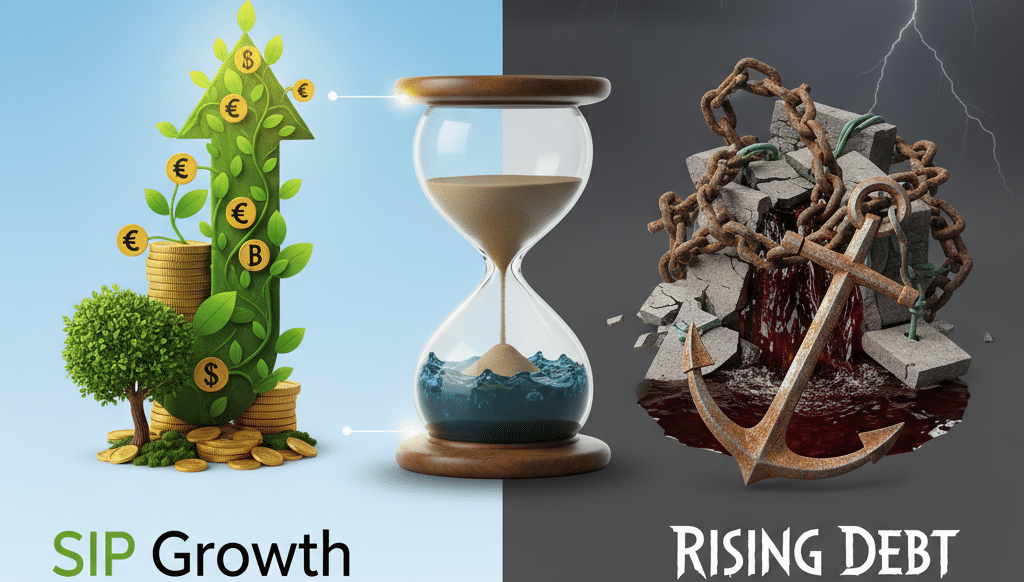
The landscape of personal finance in India is undergoing a significant transformation, marked by a surge in mutual fund investments alongside rising household debt. As of October 2025, monthly systematic investment plan (SIP) contributions have reached an all-time high of ₹29,529 crore, reflecting a growing trend among investors. However, this financial optimism is tempered by a troubling increase in household liabilities, which have outpaced asset growth, raising questions about the true financial health of the middle class.
The Record SIP Contributions and Investor Behavior
Recent data reveals a dual narrative in India’s financial sector. October 2025 saw SIP inflows hit a record ₹29,529 crore, a slight increase from the previous month, indicating a robust post-pandemic recovery in systematic investing. The assets linked to SIPs have now surpassed ₹16.25 lakh crore, accounting for approximately 20% of the mutual fund industry’s total assets under management (AUM). This growth is particularly notable as SIPs have transitioned from being a niche investment option to a mainstream choice for many investors.
Interestingly, the trend extends beyond metropolitan areas, with smaller towns contributing over ₹10,000 crore to monthly SIP inflows. This shift highlights the penetration of the SIP culture into the broader Indian market, reaching beyond the traditional urban centers. However, despite these impressive figures, the SIP stoppage ratio remains concerningly high, hovering around 75%. This statistic indicates that a significant portion of registered SIPs are being discontinued or allowed to lapse, suggesting that many investors may be facing financial strain despite the influx of new capital.
The Rising Debt Crisis
A closer examination of household finances reveals a stark contrast to the optimistic SIP figures. Analysis of Reserve Bank of India (RBI) data shows that household financial liabilities have surged by approximately 102% from 2019-20 to 2024-25, while financial assets have only increased by 48% during the same period. This imbalance has resulted in a rising share of liabilities in relation to GDP, with household debt climbing from about 36% to roughly 42% over two years.
Moreover, the overall household savings rate has declined to approximately 18.1% of GDP, marking a third consecutive year of decrease. This trend indicates that more families are relying on credit to finance their consumption, leading to a precarious financial situation. The net household financial savings, which account for the difference between financial assets and liabilities, have plummeted to just over 5% of GDP, the lowest level in over a decade. This growing reliance on debt raises critical questions about the sustainability of the current financial practices among the middle class.
Real-Life Implications: Four Family Scenarios
To illustrate the impact of these financial trends, consider four hypothetical families navigating the complexities of SIPs and EMIs.
The first family, Rajesh and Sunita, represent the lower-middle class. They earn a combined income of approximately ₹55,000 per month and have minimal savings. Their SIP contributions are modest, but they often struggle with credit card debt, highlighting the pressure to invest despite financial instability.
Next, Neha and Karan, an emerging middle-class couple, earn around ₹1.6 lakh monthly. They manage significant EMIs for their home and car loans while attempting to invest ₹25,000 in SIPs. Their financial situation is precarious, as any increase in expenses could lead them to rely on credit.
The third scenario features Meera and Arjun, a dual-income household in Mumbai earning ₹4.5 lakh monthly. Despite their substantial investments in SIPs, their high EMIs leave them feeling financially strained, often resorting to credit for additional expenses.
Lastly, Aayushi, a gig worker earning between ₹35,000 and ₹40,000, represents the aspirational solo earner. Her small SIP is a symbolic gesture of financial responsibility, yet she faces the challenge of managing high-cost debt, which grows faster than her investments.
The SIP Boom: A Mask for Financial Stress?
While the increasing popularity of SIPs signifies a positive shift towards financial literacy and investment, it also raises concerns about underlying financial stress. Many households are adopting SIPs as a way to project financial responsibility, even as they grapple with rising debt levels. The elevated SIP stoppage ratio serves as a warning sign, indicating that when financial pressures mount, investors may prioritize stopping SIPs over defaulting on essential loans.
The current financial landscape suggests that while the middle class is more engaged with capital markets, they may be doing so from a position of anxiety rather than surplus. The challenge lies in ensuring that families are not merely using SIPs as a psychological band-aid for their financial insecurities. As the trend of financialization continues, it is crucial for individuals to maintain a balanced approach to debt and investment, ensuring that their financial practices are sustainable in the long term.
Observer Voice is the one stop site for National, International news, Sports, Editor’s Choice, Art/culture contents, Quotes and much more. We also cover historical contents. Historical contents includes World History, Indian History, and what happened today. The website also covers Entertainment across the India and World.
Follow Us on Twitter, Instagram, Facebook, & LinkedIn

