

Understanding the Union Budget: Definition, Significance, and Process Explained

India is gearing up for a significant moment in its fiscal calendar as the Union Budget is set to be presented in Parliament on February 1. This will mark the 15th budget presentation under Prime Minister Narendra Modi’s administration, with Finance Minister Nirmala Sitharaman taking the stage for her ninth consecutive time. The Union Budget, which outlines the government’s financial plans for the upcoming fiscal year, has been scheduled for February 1 since 2017, shifting from its traditional date of February 28. This year’s budget will be particularly noteworthy as it represents the second full annual budget of the Modi 3.0 government.
Understanding the Union Budget
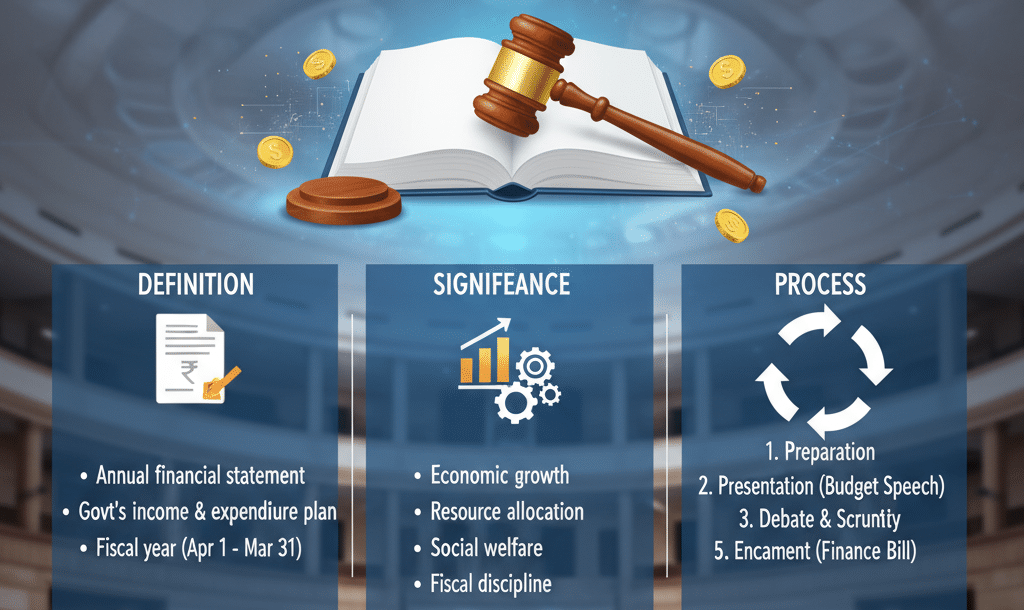
The Union Budget is a crucial document that reflects the government’s estimated receipts and expenditures for the fiscal year, as mandated by Article 112 of the Indian Constitution. It is divided into two main components: the Revenue Budget and the Capital Budget. The Revenue Budget details the government’s income, primarily from tax and non-tax sources, and outlines its spending on day-to-day operations and public services. If expenditures exceed revenues, it results in a revenue deficit.
On the other hand, the Capital Budget focuses on long-term investments and expenditures, such as infrastructure development. This includes funds allocated for building roads, hospitals, and schools. Capital receipts often come from loans, while capital expenditures are aimed at enhancing the nation’s growth potential. A fiscal deficit occurs when total spending surpasses total income, indicating a need for borrowing or other financial strategies.
The Significance of the Union Budget
The Union Budget plays a pivotal role in shaping India’s economic landscape. It is an annual practice that outlines the government’s financial goals and resource allocation strategies. The budget is particularly important during election years, where it may be split into an Interim Budget and a final budget, as seen in the 2024-2025 budget due to the upcoming Lok Sabha elections.
The budget’s implications extend beyond mere numbers; it signals the government’s priorities and areas of focus. By determining which sectors receive funding, the budget influences investment decisions and economic growth. It also addresses key issues such as taxation, directly impacting citizens’ financial planning for the year ahead. The budget sets income tax slabs, rates, and deductions, shaping the financial landscape for individuals and businesses alike.
The Union Budget Process
The process of formulating the Union Budget begins with the President of India, who plays a constitutional role in its presentation. Under Article 87, the President addresses a joint session of both Houses of Parliament at the start of the first session after a general election and at the beginning of each year. This address outlines the government’s policies and priorities, setting the tone for the upcoming budget.
Following the President’s address, a “Motion of Thanks” is moved in both Houses, allowing members to debate and formally acknowledge the government’s roadmap. The President’s recommendation is crucial for Money Bills, including the Budget, making this step essential for its presentation. The entire process reflects the collaborative nature of governance in India, with the President serving as a vital link between the executive and legislative branches.
Traditions and Rituals Surrounding the Budget
The presentation of the Union Budget is steeped in tradition and rituals that add a cultural dimension to the event. One such ritual is the offering of dahi-cheeni (curd and sugar) by President Droupadi Murmu to Finance Minister Nirmala Sitharaman, symbolizing good luck and blessings for a successful budget presentation. This practice has gained renewed significance in recent years.
Another notable tradition is the halwa ceremony, which takes place before the budget documents are finalized. During this ceremony, the finance minister participates in a symbolic event that marks the beginning of a confidential period leading up to the budget presentation. Additionally, the colonial-era briefcase has been replaced by a red, folded cloth known as a bahi-khata, introduced by Sitharaman, which carries the budget papers. These rituals not only highlight the importance of the budget but also reflect the cultural heritage of India.
Observer Voice is the one stop site for National, International news, Sports, Editor’s Choice, Art/culture contents, Quotes and much more. We also cover historical contents. Historical contents includes World History, Indian History, and what happened today. The website also covers Entertainment across the India and World.
Follow Us on Twitter, Instagram, Facebook, & LinkedIn

