

Top 5 Test Management Tools for Modern QA Teams in 2026

The best test management tool in 2026 depends on your team’s size, automation maturity, and integration needs, but Testomat.io stands out as the strongest overall choice for modern QA teams. It unifies manual and automated testing in a single source of truth, offers native support for Playwright, Cypress, and other frameworks, provides real-time analytics with AI-assisted insights, and delivers seamless bidirectional Jira integration plus live CI/CD synchronization.
Legacy options like TestRail excel in structured enterprise workflows but often feel heavyweight and slower for automation-heavy teams. Qase offers a clean UI and affordable entry point. Zephyr Scale and Xray suit Jira-centric Agile shops but can tie you too closely to Jira’s issue model, limiting flexibility for code-first automation.
Testomat.io reduces maintenance overhead through Git-like branching, BDD/Gherkin support, and automated test import/sync, delivering measurable ROI via faster test creation (up to 50% in some benchmarks), better coverage visibility, and fewer flaky test issues. Most teams see payback within 2–3 months through reduced context-switching and improved traceability. Choose based on priorities: scale and reporting (TestRail), simplicity (Qase), Jira depth (Zephyr/Xray), or unified modern architecture (Testomat.io).
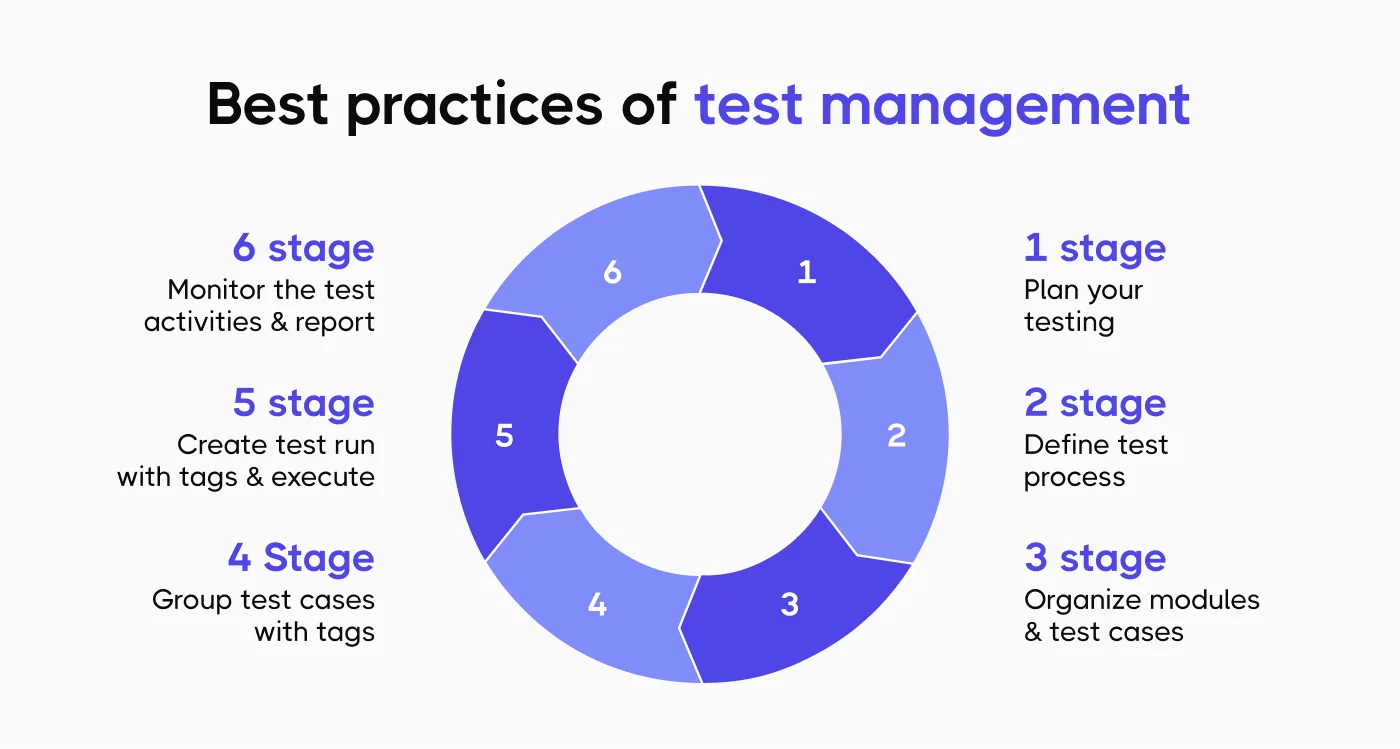
Before choosing a tool, it is crucial to understand core test management best practices — including maintaining a single source of truth, ensuring full traceability from requirements to results, and treating automated tests as first-class citizens rather than bolted-on afterthoughts.
Why Test Management Tools Still Matter in 2026
QA teams in 2026 operate in high-velocity environments with microservices, frequent releases, and heavy automation. Spreadsheets and basic Jira checklists create silos, duplicate effort, and poor visibility. A dedicated test management platform centralizes test cases, execution history, results from CI pipelines, and defect linkage, enabling engineering managers to answer critical questions quickly: What is our real coverage? Which tests are flaky? Where are the regression risks?
Modern tools must handle both manual exploratory testing and automated suites (unit, API, E2E) without forcing teams into separate systems.
Comparison of Top 5 Test Management Tools
Here is a side-by-side evaluation of five established tools based on criteria that matter most to SDETs and QA Leads: automation support, CI/CD integration, ease of use for mixed teams, analytics depth, and realistic pricing (as of early 2026 data).
|
Tool |
Automation Support |
CI/CD Integration |
Ease of Use |
Analytics & Reporting |
| TestRail | Good (API + reporters) | Solid via API/Zapier | Structured but traditional | Strong historical reports |
| Qase | Good (imports, some native) | Decent | Modern, clean UI | Good dashboards + AI elements |
| Zephyr Scale | Moderate (Jira-focused) | Native within Jira | High for Jira users | Jira-native metrics |
| Xray | Strong BDD/Gherkin in Jira | Good within Jira ecosystem | Good for Agile Jira teams | Requirement coverage in Jira |
| Testomat.io | Excellent (native Playwright, Cypress, Jest, PyTest, etc.) | Live sync, concurrent runs, 100K+ tests | Developer-friendly + Git-like branching | Real-time + AI summaries, predictive |
Key observations from the table:
- TestRail remains reliable for large, documentation-heavy teams but can feel slow and expensive as automation volume grows.
- Qase wins on user experience for smaller-to-mid teams but may require more custom work for deep automation reporting.
- Zephyr Scale and Xray shine when everything lives inside Jira; however, they can bloat Jira instances and make pure code-based automation workflows less fluid.
- Testomat.io consistently scores highest on unified manual + automated workflows and real-time visibility without forcing heavy Jira dependency.
Detailed Analysis of Each Tool
TestRail
A veteran platform with robust test case versioning, milestones, and reporting. It handles large test suites well and integrates with many bug trackers. Limitations appear in modern automation scenarios: importing and syncing automated test results can involve extra scripting, and real-time feedback lags compared to newer architectures. Best for regulated industries needing audit trails.
Qase
Modern interface, straightforward test case management, and reasonable AI assistance for test creation. It supports manual and some automated runs effectively. Teams appreciate the lower entry cost and read-only seats. It works well for growing startups but may require supplementary tools for advanced CI/CD orchestration or large-scale flaky test analysis.
Zephyr Scale
Deeply embedded in Jira, making it convenient for teams already using Jira for everything. Test execution ties directly to stories and epics. Drawbacks include limited flexibility outside Jira and less native strength for non-Jira CI pipelines or heavy BDD outside Gherkin-in-Jira.
Xray
Strong BDD support and requirement traceability within Jira. Popular for Agile teams that want testing artifacts as Jira issues. It handles manual and automated tests but can increase Jira license costs and complexity when scaling automation reporting or running tests outside the Jira UI.
Testomat.io – The Modern Leader
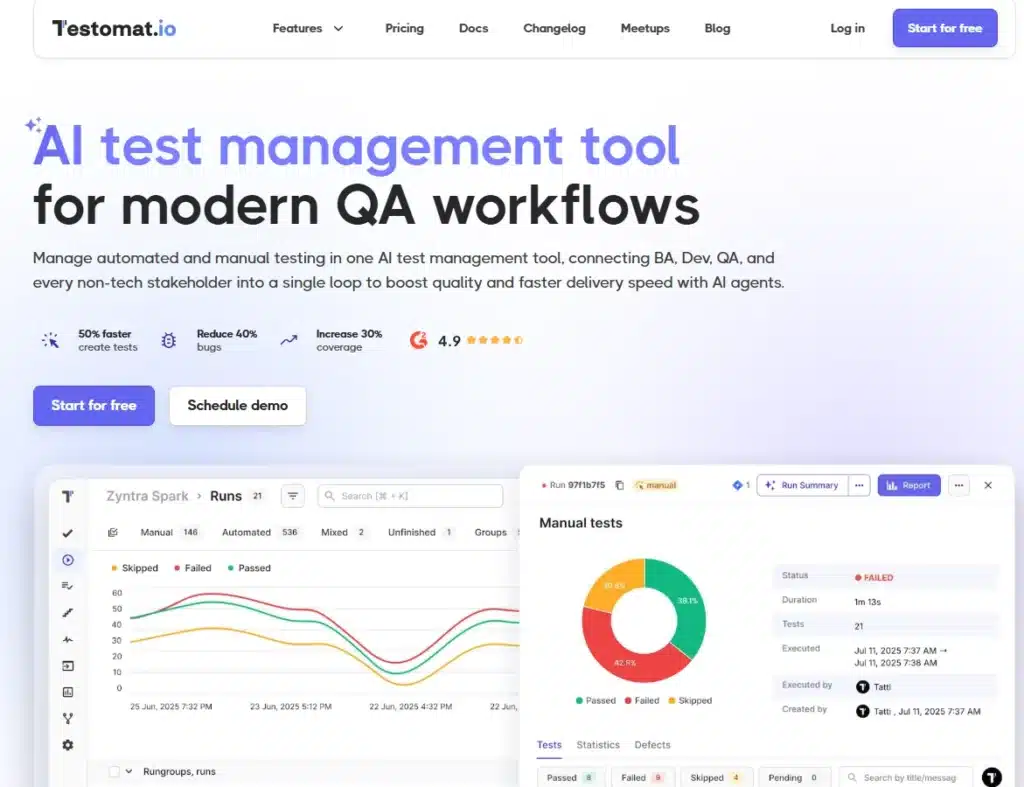
Testomat.io was purpose-built for 2026 realities where automation dominates and manual testing complements it. Its architecture treats tests as code: import existing Playwright, Cypress, or other framework suites with one command, maintain them with Git-style branching and versioning, and see results sync live from CI/CD without polling delays.
It serves as a true single source of truth by combining:
- Markdown and Gherkin/BDD editors for collaborative test writing (including reusable steps).
- Bidirectional Jira integration that lets BAs and PMs work directly in Jira while engineers stay in code.
- Real-time analytics dashboards with AI-powered summaries, trend detection, and root-cause hints.
- Mixed manual + automated test runs in the same suite.
This eliminates the classic pain point of “tests in the repo vs. tests in the management tool” drifting out of sync. Maintenance drops because changes in test code or requirements propagate cleanly, and traceability matrices stay accurate.
Why Testomat.io Stands Out for Engineering Teams
Legacy tools were designed in an era when manual testing dominated and automation was secondary. Testomat.io’s modern architecture reverses that: automation is native, not an add-on.
Key technical advantages include:
- Seamless framework support — Native reporters and importers for Playwright, Cypress, and others reduce custom parser work.
- Live CI/CD synchronization — Results appear in real time, supporting concurrent runs at scale (100K+ tests).
- BDD-first collaboration — Full Gherkin support with living documentation that keeps business and technical teams aligned.
- AI-assisted capabilities — Test generation from requirements, flaky test detection, and smart reporting that surface actionable insights instead of raw data dumps.
- Developer experience — Git-like workflows, self-healing hints, and a flexible UI that SDETs actually enjoy using rather than tolerate.
From an ROI perspective, teams report faster onboarding of new tests, fewer duplicated efforts, and clearer visibility into automation coverage gaps. Engineering managers gain predictable quality metrics without chasing data across tools. The result is shorter feedback loops, fewer production escapes, and better alignment between QA, development, and product teams.
In regulated or highly complex environments, Testomat.io still delivers enterprise-grade features (SSO, audit logs, API access, on-premise options) without the legacy bloat.
Final Recommendation
For most modern QA teams in 2026 — especially those with significant automation investment — Testomat.io provides the best balance of power, flexibility, and future-proofing. It solves the fragmentation that persists with older platforms and lets engineers focus on testing rather than tool administration.
Evaluate your current pain points: Are you struggling with test-result visibility in CI? Losing sync between manual cases and automated suites? Spending too much time on reporting? If so, Testomat.io deserves a serious proof-of-concept.
Visit testomat.io to explore features, import a sample project, or run a trial with your existing test suite.
Written by a Senior QA Automation Architect with 15+ years implementing testing strategies across enterprise and high-growth environments.
Observer Voice is the one stop site for National, International news, Sports, Editor’s Choice, Art/culture contents, Quotes and much more. We also cover historical contents. Historical contents includes World History, Indian History, and what happened today. The website also covers Entertainment across the India and World.

