

Neville Chamberlain: British Prime Minister and Appeasement

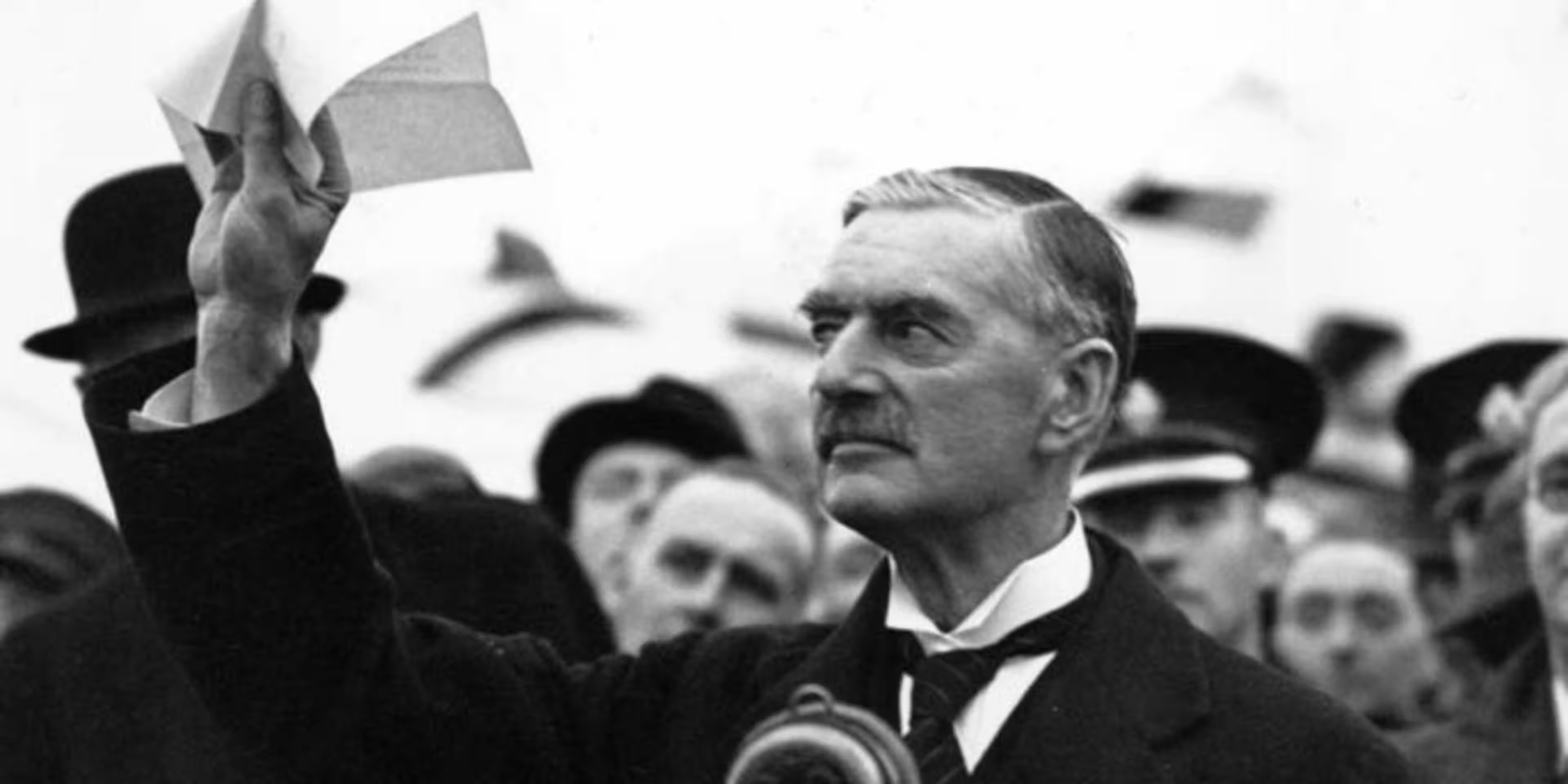
Neville Chamberlain (18 March 1869 – 9 November 1940) was a British politician who served as Prime Minister of the United Kingdom from May 1937 to May 1940. He is best known for his foreign policy of appeasement toward Nazi Germany, particularly his signing of the Munich Agreement on 30 September 1938, which ceded the German-speaking Sudetenland region of Czechoslovakia to Adolf Hitler.
Early Life and Education
Arthur Neville Chamberlain was born on 18 March 1869 at Southbourne in the Edgbaston district of Birmingham. He was the only son of Joseph Chamberlain’s second marriage; his mother was Florence Kenrick, a cousin of William Kenrick MP, who died when he was young. His elder half-brother was Austen Chamberlain. The Chamberlain family were Unitarian, though Joseph lost personal religious faith by the time Neville was six. Neville described himself as a Unitarian with no stated faith and a “reverent agnostic.”
Chamberlain was educated at home by his elder sister Beatrice and later at Rugby School. He attended Mason College, now the University of Birmingham, but showed little interest in his studies. In 1889, his father apprenticed him to a firm of accountants. Joseph Chamberlain then sent him to establish a sisal plantation on Andros Island in the Bahamas, where he spent six years; the venture failed, costing Joseph Chamberlain £50,000.
On his return to England, Chamberlain purchased Hoskins & Company, a manufacturer of metal ship berths, and served as managing director for 17 years while the company prospered. He involved himself in civic activities in Birmingham and in 1906 became a founding member of the national United Hospitals Committee of the British Medical Association. In 1911, he married Anne Cole, whom he had met through his Aunt Lilian. The couple had a son and a daughter.
Career and Achievements
Chamberlain entered local politics in 1911, standing successfully as a Liberal Unionist for Birmingham City Council. He became chairman of the Town Planning Committee and under his direction Birmingham adopted one of the first town planning schemes in Britain. In 1915, he became Lord Mayor of Birmingham and was appointed a member of the Central Control Board on liquor traffic.
In December 1916, Prime Minister David Lloyd George offered Chamberlain the position of Director of National Service, responsible for co-ordinating conscription and ensuring essential war industries had sufficient workforces. His tenure was marked by conflict with Lloyd George; in August 1917, having received little support from the Prime Minister, Chamberlain resigned. He then stood for the House of Commons as Unionist candidate for Birmingham Ladywood. At the 1918 general election, he was elected with almost 70% of the vote and a majority of 6,833, becoming an MP at age 49.
Chamberlain threw himself into parliamentary work and served as chairman of the national Unhealthy Areas Committee from 1919 to 1921, visiting slums in London, Birmingham, Leeds, Liverpool, and Cardiff. He was rapidly promoted in 1923 to Minister of Health and then Chancellor of the Exchequer. After a Labour-led government, he returned as Minister of Health from 1924 to 1929, introducing reform measures. He was appointed Chancellor of the Exchequer in the National Government in 1931.
Chamberlain succeeded Stanley Baldwin as Prime Minister on 28 May 1937 and also became Leader of the Conservative Party. His premiership was dominated by policy toward an increasingly aggressive Germany. His actions at Munich were widely popular among the British at the time. In response to Hitler’s continued aggression, Chamberlain pledged the United Kingdom to defend Poland’s independence if attacked. Following the invasion of Poland on 1 September 1939, which marked the beginning of the Second World War, Chamberlain announced the declaration of war on Germany two days later and led the United Kingdom through the first eight months of the war.
The failure of Allied forces to prevent the German invasion of Norway caused the House of Commons to hold the Norway Debate in May 1940. Chamberlain’s conduct of the war was heavily criticised by members of all parties, and in a vote of confidence, his government’s majority was greatly reduced. Accepting that a national government supported by all main parties was essential, Chamberlain resigned the premiership on 10 May 1940 because the Labour and Liberal parties would not serve under his leadership. He was succeeded as Prime Minister by Winston Churchill, though he remained Leader of the Conservative Party and served as Lord President of the Council in the war cabinet until ill health forced his resignation on 22 September 1940. Chamberlain died aged 71 on 9 November 1940 of cancer, six months after leaving the premiership.
Notable Events and Milestones
The Munich Agreement, signed on 30 September 1938, stands as the defining moment of Chamberlain’s premiership. The agreement ceded the Sudetenland to Nazi Germany and was widely popular in Britain at the time. Chamberlain’s pledge to defend Poland’s independence, made in response to Hitler’s continued aggression, brought the United Kingdom into war after Germany invaded Poland on 1 September 1939. Chamberlain announced the declaration of war on Germany on 3 September 1939, initiating British involvement in the Second World War. His resignation on 10 May 1940 marked the end of his premiership and the beginning of Churchill’s wartime leadership.
Observer Voice is the one stop site for National, International news, Sports, Editor’s Choice, Art/culture contents, Quotes and much more. We also cover historical contents. Historical contents includes World History, Indian History, and what happened today. The website also covers Entertainment across the India and World.

