

Lonnie Donegan: King of Skiffle

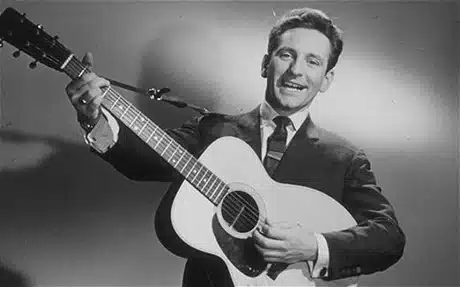
Lonnie Donegan (29 April 1931 – 3 November 2002) was a British skiffle singer, songwriter and musician referred to as the “King of Skiffle”. He influenced 1960s British pop and rock musicians, rising to prominence with his hit recording of “Rock Island Line”, which helped spur the broader UK skiffle movement.
Early Life and Education
Donegan was born in Bridgeton, Glasgow, Scotland, on 29 April 1931, the son of an Irish mother, Mary Josephine Deighan, and a Scots father, Peter John Donegan, a professional violinist who had played with the Scottish National Orchestra. When Donegan was two years old, the family moved to East Ham in Essex. During the Second World War, he was evacuated to Cheshire to escape the Blitz and attended St Ambrose College in Hale Barns. He later lived on Chiswick Mall in Middlesex.
As a child in the early 1940s, Donegan listened to swing jazz and vocal acts and became interested in the guitar. Country and western and blues records, particularly by Frank Crumit and Josh White, attracted his attention. He bought his first guitar at 14 in 1945 and learned songs such as “Frankie and Johnny”, “Puttin’ On the Style”, and “The House of the Rising Sun” by listening to BBC radio broadcasts.
Career and Achievements
By the end of the 1940s, Donegan was playing guitar around London and visiting small jazz clubs. Chris Barber heard he was a good banjo player and asked him to audition on a train. Though Donegan had never played the banjo, he bought one for the audition and succeeded more on personality than talent. His stint with Barber’s trad jazz band was interrupted when he was called up for national service in 1949. While in the army at Southampton, he was the drummer in Ken Grinyer’s Wolverines Jazz Band at a local pub. A posting to Vienna brought him into contact with American troops and access to US records and the American Forces Network radio station.
In 1952, Donegan formed the Tony Donegan Jazzband, which played around London. On 28 June 1952 at the Royal Festival Hall, they opened for blues musician Lonnie Johnson, from whom Donegan adopted his first name as a tribute. In 1953, he joined Ken Colyer’s Jazzmen alongside Chris Barber. On 12 April 1953, Chris Albertson recorded Ken Colyer’s Jazzmen and the Monty Sunshine Trio—Sunshine, Barber, and Donegan—for Storyville Records, among Donegan’s first commercial recordings.
While in Ken Colyer’s Jazzmen, Donegan began playing with two other band members during intervals to provide what posters called a “skiffle” break. In July 1954, he recorded a fast version of Lead Belly’s “Rock Island Line”, which became a hit in 1956. It was the first debut record to go gold in the UK and reached the top 10 in the United States. Though it was a band recording and Donegan made no money beyond his session fee, the song helped define the new skiffle style—music made with simple acoustic instruments like acoustic guitar, washtub bass, and washboard rhythm.
Donegan’s next single for Decca, “Diggin’ My Potatoes”, was recorded at a concert at the Royal Festival Hall on 30 October 1954. Decca dropped him thereafter, but within a month he was at Abbey Road Studios recording for EMI’s Columbia label. By spring 1955, he had signed a recording contract with Pye. His single “Lost John” reached number two in the UK Singles Chart. He appeared on television in the United States on the Perry Como Show and the Paul Winchell Show. In summer 1956, he recorded his debut album, Lonnie Donegan Showcase, with songs by Lead Belly and Leroy Carr, plus “Ramblin’ Man” and “Wabash Cannonball”. The LP sold hundreds of thousands.
Donegan’s “Gamblin’ Man”/”Puttin’ On the Style” single was number one in the UK in July 1957, the same month John Lennon first met Paul McCartney. His skiffle rendition of Hank Snow’s “Nobody’s Child” inspired Tony Sheridan’s blues version, which he recorded with the Beatles as his backing band. Donegan went on to successes such as “Cumberland Gap” and “Does Your Chewing Gum Lose Its Flavour (On the Bedpost Overnight?)”, his biggest hit in the US. He turned to music hall style with “My Old Man’s a Dustman”, which reached number one in the UK in 1960 but was unsuccessful in America. His last hit single on the UK chart was his cover version of “Pick a Bale of Cotton”. His fall from the chart coincided with the rise of the Beatles and other beat music performers whom he inspired.
Donegan had 31 UK top-30 hit singles, 24 of which were successive hits, and three were number one. He was the first British male singer with two US top-10 hits. He was a pivotal figure in the British Invasion due to his influence in the US in the late 1950s.
During the 1960s, Donegan recorded sporadically, including sessions at Hickory Records in Nashville with Charlie McCoy, Floyd Cramer, and the Jordanaires. After 1964, he was a record producer for most of the decade at Pye Records, working with artists including Justin Hayward. In 1965, when Hayward was 17, Donegan persuaded him to sign an eight-year publishing contract as a songwriter, a move Hayward later regretted, as it meant the rights to all his Moody Blues songs written before 1974 would be owned by Donegan’s Tyler Music.
Donegan was not popular through the late 1960s and 1970s, although his “I’ll Never Fall in Love Again” was recorded by Tom Jones in 1967 and Elvis Presley in 1976. He began to play the American cabaret circuit. In June 1975, he reunited with the original Chris Barber band for a concert in Croydon. A bomb scare meant the recording had to be finished in the studio after an impromptu concert in the car park. The release was titled The Great Re-Union Album. He collaborated with Rory Gallagher on several songs, notably “Rock Island Line”.
Donegan had his first heart attack in 1976 while in the United States and had quadruple bypass surgery. He returned to attention in 1978, when he recorded his early songs with Rory Gallagher, Ringo Starr, Elton John, and Brian May on the album Putting on the Style. By 1980, he was making regular concert appearances again. In 1983, Donegan toured with Billie Jo Spears, and in 1984, he made his theatrical debut in a revival of the 1920 musical Mr Cinders. In 1992, he had further bypass surgery following another heart attack.
In 1994, the Chris Barber band celebrated 40 years with a tour featuring both bands. Pat Halcox remained on trumpet, a position he retained until July 2008. Donegan had a late renaissance when in 2000, he appeared on Van Morrison’s album The Skiffle Sessions – Live in Belfast 1998, an acclaimed album featuring him singing with Morrison and Chris Barber, with a guest appearance by Dr John. Donegan also played at the Glastonbury Festival in 1999. He appeared at Fairport Convention’s annual music festival on 9 August 2001. His final CD was This Yere de Story.
Pantomime Career
Donegan frequently appeared in pantomime, for example as “Buttons” in Cinderella in Nottingham. During his three years in the role there, he met actress Jill Westlake, who played the title role. The couple announced their engagement in 1964 and later married. Donegan reprised his role as Buttons in Glasgow’s Alhambra Theatre in 1966, his first Scottish season. The Ugly Sisters were played by Stanley Baxter and Ronnie Corbett.
Awards and Honors
Donegan received an Ivor Novello lifetime achievement award in 1995. In 2000, he was appointed MBE.
Additional Resources
More detailed information about Lonnie Donegan’s life, recordings, and influence on British music is available through Wikipedia and other biographical archives.

