

India Champions Sustainable Growth at World Sustainable Development Summit 2026

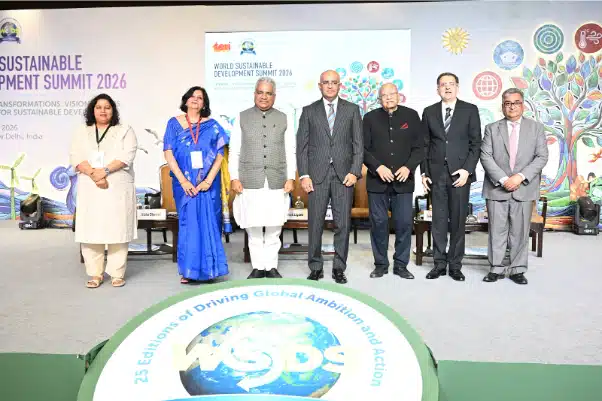
In a powerful valedictory address marking the Silver Jubilee of TERI’s World Sustainable Development Summit (WSDS) 2026, Shri Tanmay Kumar, Secretary of the Union Ministry of Environment, Forest and Climate Change, emphasized India’s unique approach to development. The event in New Delhi featured notable dignitaries, including Ms. Dia Mirza, Goodwill Ambassador for the United Nations Environment Programme, and other esteemed representatives from environmental organizations.
Shri Kumar highlighted India’s commitment to a development model that harmoniously balances growth, poverty alleviation, urbanization, industrialization, and decarbonization, contrasting sharply with the high-emission paths taken by developed nations throughout history. He noted that climate change has evolved from a mere environmental issue to a pressing challenge affecting governance, security, and human welfare.
A Call for Global Action
During his address, Kumar referred to the Paris Agreement’s first Global Stocktake, which urges a 43% reduction in global emissions by 2030. He criticized the lack of action from developed countries, emphasizing that they have contributed nearly half of global CO₂ emissions from 1850 to 2019, while India’s contribution remains minimal. Despite housing 17% of the world’s population, India’s per capita emissions are about two tonnes annually, significantly lower than the global average.
Vision for a Sustainable Future
Looking towards the future, Shri Kumar spoke of ‘Viksit Bharat’ by 2047, which envisions a developed India that prioritizes sustainability rather than replicating past industrial models. This vision includes cities designed for efficient public transport, industries powered by renewable energy sources, and a transition towards a circular economy.
He stressed principles of equity and intergenerational justice, stating that India will not address past poverty at the expense of creating ecological crises for future generations. India’s ecological progress was underscored by recent FAO reports, placing the country ninth globally in forest area and third in annual net forest gain.
Commitments and Initiatives in Environmental Governance
Kumar detailed several reforms from the Ministry aimed at strengthening environmental governance, such as the Green Credit Programme and various new rules focused on environmental management and audits. These initiatives reflect India’s dedication to fostering transparent and effective environmental policies that support inclusive economic growth.
On fulfilling climate commitments, he shared that India is on track to achieve a 45% reduction in emission intensity of GDP by 2030 with a successful early achievement of a 50% share of electric power capacity from non-fossil fuel sources by mid-2025. The country is also revising its Nationally Determined Contributions (NDCs) to strengthen its climate action strategy.
Collaboration and Climate Action
In conjunction with the WSDS, the Ministry of Environment, Forest and Climate Change launched Him-CONNECT, a platform connecting Himalayan researchers with startups and policymakers to foster collaborative solutions. The summit concluded with the unveiling of the Act4Earth Manifesto, reinforcing commitments to advance climate action in unity.
Observer Voice is the one stop site for National, International news, Sports, Editor’s Choice, Art/culture contents, Quotes and much more. We also cover historical contents. Historical contents includes World History, Indian History, and what happened today. The website also covers Entertainment across the India and World.

