

India and China Invest in the Northern Sea Route: Implications from Suez to Russia’s Arctic

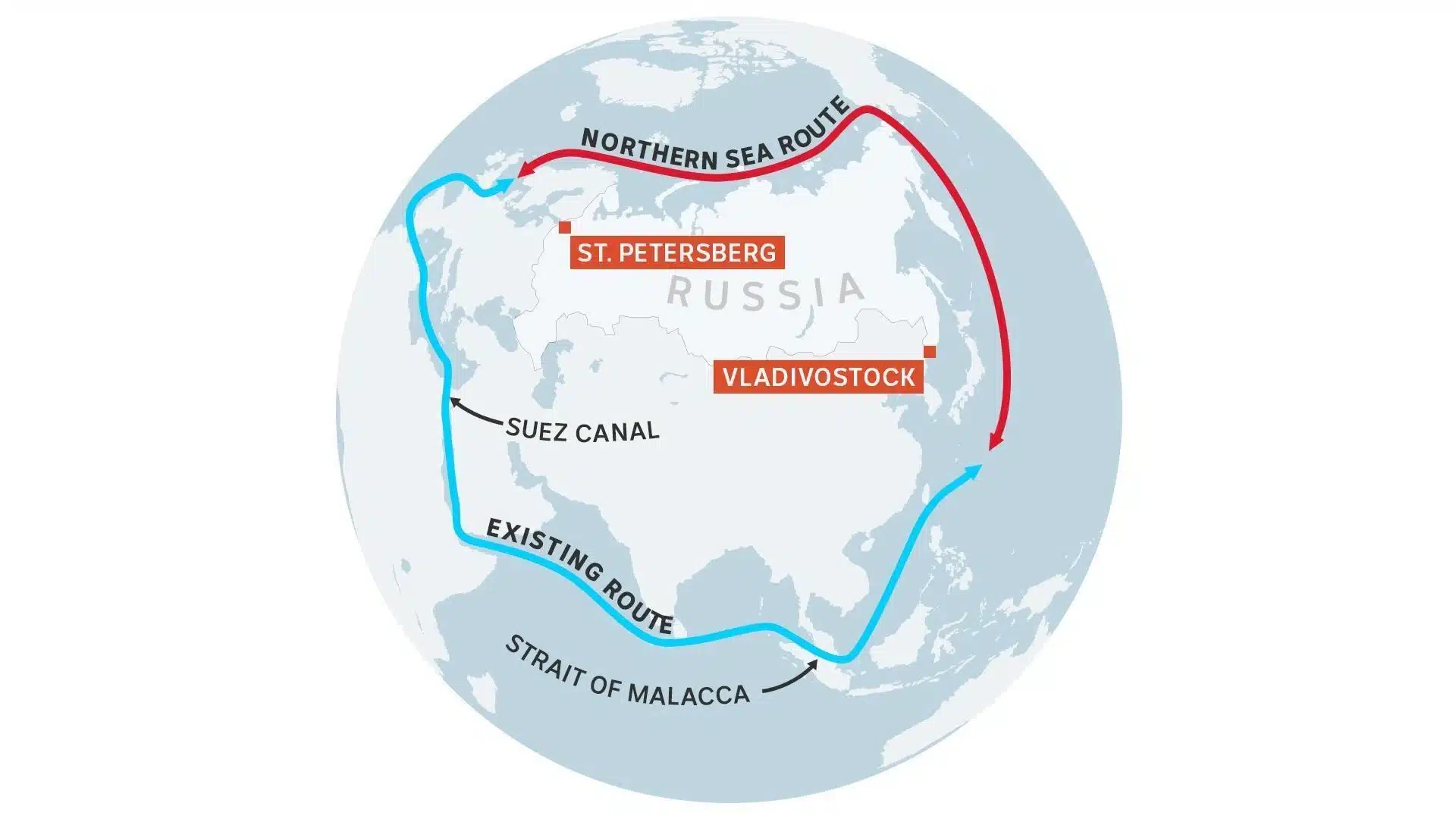
India is set to send its first cargo ship through the Northern Sea Route (NSR) in 2027, as the country reassesses its supply chain strategies amid ongoing geopolitical tensions. The NSR, which runs along Russia’s northern coast, is gaining attention due to disruptions in traditional trade routes like the Strait of Hormuz and the Suez Canal. With the ongoing conflicts in the Middle East, including the US-Iran war and Houthi attacks, major economies such as India are exploring alternative maritime pathways.
Understanding the Northern Sea Route
The Northern Sea Route connects Russia’s western ports to Asian markets via Arctic waters. This seasonal route is typically navigable from July to September and spans over 5,500 kilometers. Its significance has increased as traditional routes face disruptions. Russia is investing in infrastructure to enhance the NSR’s capacity as an international trade corridor, allowing it to ship cargo to Asia without the risk of inspections related to sanctions. Reports indicate that Russian crude oil shipments via the Arctic have surged, with millions of barrels dispatched to Asia this year.
India’s Plans for the NSR
India’s interest in the NSR is driven by its commercial potential and the desire to enhance trade connectivity. The route offers a geographical advantage for certain Asia-Europe trade lanes, particularly those linking Asian ports with northern Europe. Discussions are underway with Russia’s Arkhangelsk region regarding the use of ports for Indian exports and imports, shipbuilding, and potential production facilities. The region also provides access to valuable resources such as hydrocarbons and rare earths.
India’s first pilot cargo voyage through the NSR is planned for 2027. Experts suggest that this pilot will help assess various operational factors, including transit times and port infrastructure. The NSR could complement India’s existing trade routes, particularly the Chennai-Vladivostok Eastern Maritime Corridor, which has seen a significant increase in cargo movement.
Implications for Trade
The NSR presents a distinct alternative to the Chennai-Vladivostok corridor, which has already reduced travel time between India and Russia’s Far East. Estimates indicate that the NSR could shorten travel to Europe by about 40%, or roughly two weeks. However, experts caution that while geopolitical factors may drive interest in the NSR, economic viability will ultimately determine its success.
Currently, the majority of Russian crude exports to India come from Black Sea and Baltic ports, with minimal volumes from the Arctic. The NSR’s appeal lies not in speed but in risk diversification, particularly in light of recent disruptions in the Red Sea that have forced shipping reroutes.
Challenges Ahead
Despite its potential, the NSR faces significant challenges that limit its viability as a full-time alternative to the Suez Canal. The route is heavily dependent on seasonal conditions, requiring specialized vessels and icebreaker support for navigation. High operating costs, safety concerns, and limited infrastructure further complicate its use.
Experts note that while the NSR could serve as a supplementary corridor for specific bulk commodities, it cannot currently match the scale and reliability of established routes like the Suez Canal. For India to fully leverage the NSR, it must demonstrate competitive economics and reliability, even when conventional routes are operational.
Observer Voice is the one stop site for National, International news, Sports, Editor’s Choice, Art/culture contents, Quotes and much more. We also cover historical contents. Historical contents includes World History, Indian History, and what happened today. The website also covers Entertainment across the India and World.

