

India Advances Quantum Technologies with National Quantum Mission

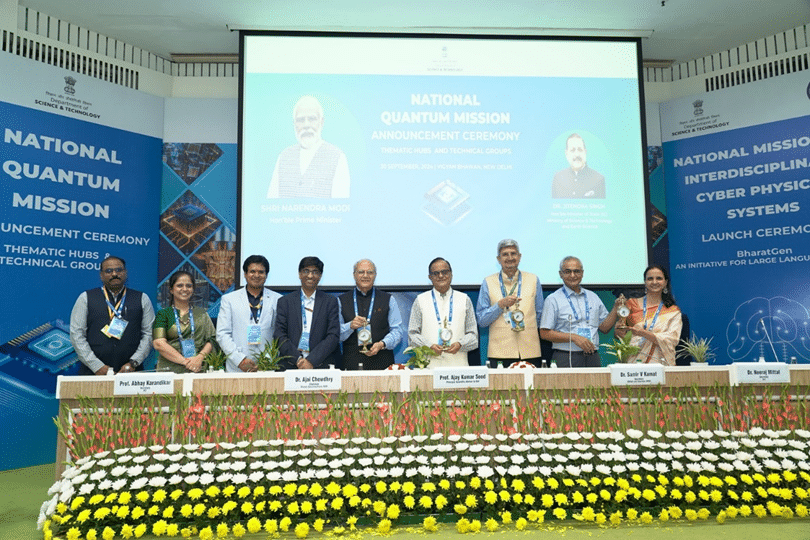
The Department of Science & Technology is making significant strides in advanced quantum technologies under the National Quantum Mission (NQM). With several initiatives in place, India is poised to enhance its capabilities in quantum computing, communication, and sensing. As of 2025, the mission has established four Thematic Hubs across premier institutions, aiming to foster innovation and development in this cutting-edge field.
Establishment of Thematic Hubs
In the fiscal year 2024–25, four dedicated Thematic Hubs (T-Hubs) have been launched: Quantum Computing at the Indian Institute of Science (IISc) Bengaluru, Quantum Communication at the Indian Institute of Technology (IIT) Madras in collaboration with C-DoT, Quantum Sensing & Metrology at IIT Bombay, and Quantum Materials & Devices at IIT Delhi. Each hub has been incorporated as Section-8 Companies and has established Hub Governing Boards to ensure effective governance and management. These hubs are now fully operational, engaged in activities such as technology development, human resource training, entrepreneurship initiatives, and international collaborations.
Advancements in Quantum Technologies
The NQM is also working on enhancing indigenous quantum hardware development through state-of-the-art fabrication and central facilities at leading institutions. Recently, the Defense Research and Development Organization (DRDO) and IIT Delhi successfully showcased quantum entanglement-based free space secure communication over a distance of 1 km on the IIT campus.
Moreover, exclusive guidelines have been introduced to support quantum startups with funding, access to national infrastructure, and mentorship opportunities. To date, eight startups have received backing. Some noteworthy achievements include:
- QuNu Labs Pvt. Ltd. developed a 500 km Quantum Key Distribution (QKD) network for secure encrypted communication.
- QpiAI created a scalable and fault-tolerant 64-qubit Quantum Processor Unit (QPU).
- Prenishq introduced a high-precision diode laser that enhances quantum communication and computing.
- PQuest Group launched India’s first indigenous Quantum Diamond Microscope (QDM) through IIT Bombay’s T-Hub.
Educational Initiatives and Workforce Development
To prepare a skilled workforce for the future, new undergraduate and master’s programs in Quantum Technologies have been initiated in collaboration with the All India Council for Technical Education (AICTE). There’s also a dedicated call for establishing Undergraduate Teaching Laboratories in Quantum Technologies aimed at promoting practical learning among students.
In tandem, a concept paper has been developed to address cybersecurity challenges posed by quantum computing. This includes recommendations for national post-quantum cryptography standards and the promotion of indigenous research and development. A specialized Task Force has also been formed to assist in transitioning to quantum-resistant cryptography.
As part of the initiative, DRDO has set up the Quantum Test and Research Centre (QTRC), which will focus on facilities such as a QKD lab and Post Quantum Cryptography testing, ensuring that India remains at the forefront of quantum technology advancements.
Observer Voice is the one stop site for National, International news, Sports, Editor’s Choice, Art/culture contents, Quotes and much more. We also cover historical contents. Historical contents includes World History, Indian History, and what happened today. The website also covers Entertainment across the India and World.

