

Decoding the Ancient Depths of the Ladakh Magmatic Arc

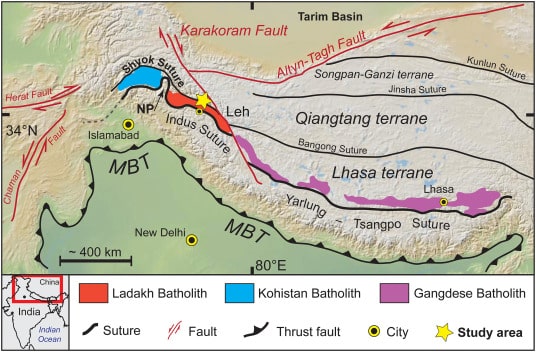
Scientists have uncovered the intricate history of the Ladakh Magmatic Arc (LMA) in the northwestern Himalaya, revealing a stunning 130-million-year record of plate tectonics that chronicles the subduction and eventual collision of the Indian and Eurasian plates. This groundbreaking study sheds light on the geological processes that shaped the region long before the Himalayas rose to their current majestic heights.
Approximately 130 million years ago, the area that is now recognized as Ladakh existed above the vast Neo-Tethys Ocean. Underneath this ancient sea, colossal slabs of Earth’s crust embarked on a journey into the mantle in a process known as subduction. This dynamic transformation gave rise to the LMA, a belt of igneous rocks that emerged between the Jurassic and Eocene periods, approximately 201.3 million to 33.9 million years ago.
Insights from Geochemical Analysis
A team of researchers from the Wadia Institute of Himalayan Geology has meticulously traced the slow but forceful movements of subduction responsible for creating the LMA. By exploring the chemical composition of rocks, they discovered that the formation of the LMA was primarily due to the northward subduction of the Neo-Tethyan oceanic plate beneath the Eurasian margin.
The team compared geochemical and isotopic data from various formations, including the pre-collisional Dras-Nidar Island Arc Complex, the Ladakh Batholith, and the post-collisional mafic dykes. Their findings indicate that the long-term evolution of magmatism in this region was heavily influenced by the geodynamics of the Neo-Tethyan Ocean.
Phases of Geological Activity
Researchers identified three significant magmatic phases within the LMA’s history—spanning from 160 million to less than 45 million years ago—each encapsulating distinct geochemical signatures shaped by the dynamics of descending tectonic slabs and the surrounding mantle and crustal materials.
The earliest phase depicted a landscape peppered with volcanic islands rising from the expansive Neo-Tethys Ocean. Evidence preserved within the Dras–Nidar Island Arc Complex suggests that magma production during this period was chiefly sourced from the mantle, with only minor contributions from subducted sediments.
As tectonic plates converged, massive granite bodies known as the Ladakh Batholith were formed deep underground, indicating enhanced chemical contributions from continental materials. This shift in magma composition correlates with the approaching collision of the Indian Plate with Eurasia, as more sediments were dragged into the mantle, altering the magma’s chemistry significantly.
Aftermath of Collision
The eventual collision between the two tectonic plates led to the closure of the Neo-Tethys Ocean and dramatically uplifted the Himalayan range. Even after this monumental event, molten rock erupted through fissures, resulting in the formation of mafic dykes—narrow sheets of dark volcanic rock that cut across older formations. These magmas, enriched by prior tectonic activities, provide further insights into the region’s geological evolution.
By studying rare elements and isotopes such as strontium and neodymium, researchers have effectively constructed a geological timeline, providing clues about the origins of the magma—whether from deep mantle sources, recycled sediments, or fragments of continental crust. Their work indicates a more significant influence of sediment subduction in the Kohistan Ladakh Batholith compared to the Dras-Nidar Island Arc Complex.
Observer Voice is the one stop site for National, International news, Sports, Editor’s Choice, Art/culture contents, Quotes and much more. We also cover historical contents. Historical contents includes World History, Indian History, and what happened today. The website also covers Entertainment across the India and World.

