Science
-

Takeaway coffee cups release thousands of microplastic particles
Xiangyu Liu, Griffith University It’s 7:45am. You grab a takeaway coffee from your local cafe, wrap your hands around the…
Read More » -
From a new flagship space telescope to lunar exploration, global cooperation – and competition – will make 2026 an exciting year for space
Grant Tremblay, Smithsonian Institution In 2026, astronauts will travel around the Moon for the first time since the Apollo era,…
Read More » -

Could ChatGPT convince you to buy something? Threat of manipulation looms as AI companies gear up to sell ads
Bruce Schneier, Harvard Kennedy School and Nathan Sanders, Harvard University Eighteen months ago, it was plausible that artificial intelligence might…
Read More » -

Rural areas have darker skies but fewer resources for students interested in astronomy – telescopes in schools can help
Emma Marcucci, Smithsonian Institution The night sky has long sparked wonder and curiosity. Early civilizations studied the stars and tracked…
Read More » -
Research institutions tout the value of scholarship that crosses disciplines – but academia pushes interdisciplinary researchers out
Bruce Weinberg, The Ohio State University; Enrico Berkes, University of Maryland, Baltimore County; Monica Marion, Indiana University, and Staša Milojević,…
Read More » -
From bolts to blue jets, lightning comes in many strange forms
Andrew Dowdy, The University of Melbourne; Jennifer Catto, University of Exeter, and Robyn Schofield, The University of Melbourne Lightning has…
Read More » -
What is below Earth, since space is present in every direction?
Jeff Moersch, University of Tennessee What is below Earth, since space is present in every direction? – Purvi, age 17,…
Read More » -
Yes, those big touchscreens in cars are dangerous and buttons are coming back
Milad Haghani, The University of Melbourne In recent years, the way drivers interact with cars has fundamentally changed. Physical buttons…
Read More » -
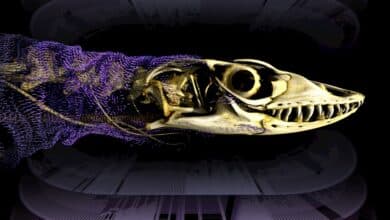
A centuries-old debate on how reptiles keep evolving skin bones is finally settled
Roy Ebel, Museums Victoria Research Institute Our bones did not begin deep inside the body. They started in the skin,…
Read More » -
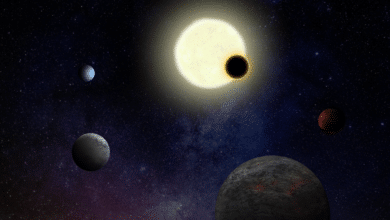
NASA’s Pandora telescope will study stars in detail to learn about the exoplanets orbiting them
Daniel Apai, University of Arizona On Jan. 11, 2026, I watched anxiously at the tightly controlled Vandenberg Space Force Base…
Read More » -
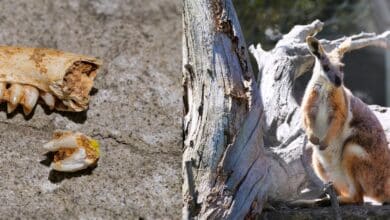
Modern rock wallabies seem to survive by sticking together in small areas. Fossils show they need to travel
Christopher Laurikainen Gaete, University of Wollongong; Anthony Dosseto, University of Wollongong, and Scott Hocknull, CQUniversity Australia Today, rock wallabies are…
Read More » -
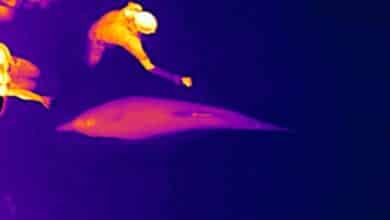
Thermal drones can track dolphin health without having to touch or disturb them
Charlie White, Flinders University and Guido J. Parra, Flinders University Marine mammals are sentinels of the sea. When dolphins and…
Read More » -
Why does mint make water taste so cold? A scientist explains
Christopher Stevens, Southern Cross University You’ve just cleaned your teeth, you’re feeling minty fresh and ready to climb into bed.…
Read More » -
As Australia bakes through an extreme heatwave, even insects aren’t immune to its impact
Caitlyn Forster, University of Sydney Australia is baking through another extreme heatwave, with temperatures forecast to reach above 45°C for…
Read More » -
What actually is fire? A physicist explains
Emma Brown, CQUniversity Australia Fire is an ancient technology that has helped shape human evolution. Our ancestors used fire for…
Read More »