

Best Ways to Make Marketing Videos From Blog Posts


You’ve invested time and expertise into your blog content. You’ve researched, written, edited, and published. And then it sits there, getting a fraction of the traffic it deserves, because written content competes on a completely different playing field than video.
The good news: your blog posts are already written scripts waiting to be produced. The structure is there — introductions, subheadings, key points, conclusions. With the right AI workflow, the fastest way to build a marketing video library isn’t to start from scratch. It’s to convert what you already have.
Pollo AI text to video makes this conversion straightforward. You take your blog content, adapt it into scene-based scripts, and let Pollo AI generate the visual layer. The result is video content that carries the same authority as your written work — distributed across channels where video performs better than text.
Why Blog-to-Video Content Repurposing Works?
Blog posts and marketing videos share the same underlying goal: communicate a useful idea to a target audience and move them toward a decision. The difference is delivery format and platform fit.
Video performs dramatically better on social media algorithms. A LinkedIn video post averages 3–5x more reach than a text post. On Instagram and YouTube, written content simply isn’t indexed in the same way. If your audience spends time on these platforms, your blog content is essentially invisible there — until you convert it.
There’s also a trust and comprehension benefit. Research consistently shows that people retain more from video explanations than from reading equivalent text. For complex products, nuanced arguments, or anything that benefits from a clear “before and after” framing, video communicates more in less time.
The ROI case is simple: you’ve already paid the creation cost for the research and ideas. Converting that content to video multiplies its distribution potential at relatively low additional cost.
Pick the Right Blog Sections for Video Conversion
Not every paragraph of a blog post translates well to video. The conversion works best when you identify the highest-density sections:
- H2 subheadings are natural scene breaks — each one can become a short video segment.
- Numbered or bulleted lists translate directly into slide-style or caption-based scenes.
- Statistics and data points work well as text-on-screen moments with supporting visuals.
- Case examples or before/after scenarios are strong visual storytelling moments.
Skip the dense explanatory paragraphs that explain background or context — those are better read than watched. Focus on the actionable, visual, and emotionally resonant parts.
Turn Headings Into Scenes and Key Takeaways Into Captions
The conversion process looks like this:
- Take each H2 from your blog post and write a one-sentence summary of its key message. This becomes your scene script for that segment.
- Pull the strongest sentence or data point from each section. This becomes your primary caption or text overlay.
- Sequence the scenes in the same order as the blog post — readers who know your content will follow the video naturally.
- Write a short intro script (10–15 seconds) that promises what the video will deliver. This replaces your blog introduction, which is usually too text-heavy for video.
- Add a CTA scene at the end that directs viewers to read the full post, visit a landing page, or take a next step.
With this structure in place, paste the full script into Pollo AI and generate your video. Pollo AI handles visual scene selection based on your text — review, adjust any scenes that need different imagery, and export.
Match Video Format to Funnel Stage
Not all marketing videos serve the same purpose. Your blog-to-video conversion strategy should match the funnel stage of the original content:
- Awareness-stage posts (what is X, why does X matter) → Short-form social clips (30–60 seconds) for Reels, Shorts, TikTok. The goal is discovery.
- Consideration-stage posts (how to choose, comparison guides) → Mid-length explainers (90 seconds–3 minutes) for YouTube or LinkedIn. The goal is education.
- Decision-stage posts (case studies, testimonials, product comparisons) → Short demo-style clips or landing page videos. The goal is conversion.
Matching format to funnel stage ensures your video content is working strategically, not just adding to content volume.
Choose the Right AI Workflow for Blog-Heavy Teams
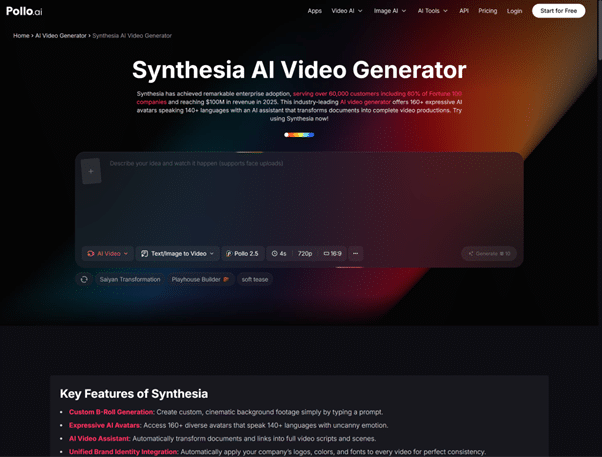
For teams that primarily produce written content and are building out a video layer, the workflow choice matters. There are two main paths:
Path A — Script-first, generative video: You adapt your blog text into a scene-by-scene script, then input it into Pollo AI for visual generation. This gives you original AI-generated scenes and strong alignment between your written voice and your video content. Best for: marketing teams, thought leadership blogs, educational content.
Path B — Text import, stock assembly: You input a blog URL or paste text, and the tool matches your content to stock footage and text overlays automatically.
If your blog content is highly specific — your own case studies, original data, proprietary frameworks — Path A through Pollo AI gives you more control and visual differentiation.
For teams whose content is more general and topical, Synthesia offer a faster automated pipeline where the AI does the scene matching for you. The trade-off is less creative control and a higher chance of visual overlap with competitors using the same stock library.
Measure Results and Improve Future Content Repurposing
Once you’ve published your blog-to-video content, measure what matters:
- Views and completion rate: High completion rate means the pacing and content are working. Under 30% completion is a signal to shorten the video or strengthen the hook.
- Click-through from video to post or landing page: This is your primary conversion metric — how many video viewers go deeper?
- Cross-channel performance: Which platform drives the most engaged viewers from your blog videos? Double down there.
- Which blog topics perform best as video: Some content formats translate better than others. How-to posts and list articles typically outperform narrative essays as video.
Use Pollo AI’s output as a feedback loop — when you find a visual style or script format that performs, codify it as your template for the next batch. Over time, your blog-to-video workflow becomes faster, more consistent, and more predictable in its results.
Observer Voice is the one stop site for National, International news, Sports, Editor’s Choice, Art/culture contents, Quotes and much more. We also cover historical contents. Historical contents includes World History, Indian History, and what happened today. The website also covers Entertainment across the India and World.

