

Maurice Chevalier: French Singer and Hollywood Star

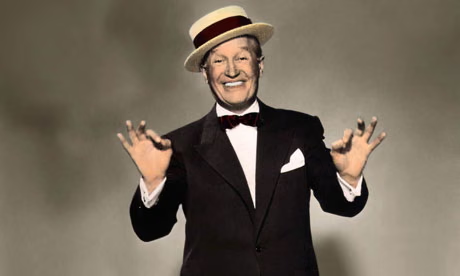
Maurice Auguste Chevalier (12 September 1888 – 1 January 1972) was a French singer, actor, and entertainer. He is best known for his signature songs including “Valentine”, “Louise”, “Mimi”, and “Thank Heaven for Little Girls”, and for his films including The Love Parade, The Big Pond, One Hour with You, and Love Me Tonight.
Early Life and Education
Chevalier was born on 12 September 1888 in Paris to Victor Charles Chevalier, a French house painter, and Joséphine, a lace-maker of Belgian descent. He had two brothers, Charles and Paul. His father abandoned the family in 1896, leaving his mother to support the children alone. After she was hospitalized from overwork in 1898, his older brother Charles took on some responsibilities until his marriage in 1900.
Determined to become an acrobat, Maurice left school at age ten but abandoned this ambition after a severe injury. He worked as a carpenter’s apprentice, electrician, printer, and doll painter before taking a job at a mattress factory. While working there, his finger was crushed in a machine, forcing him to stop. During his recovery in 1900, he offered his services as a performer at a nearby café, singing his first song, V’la Les Croquants, though his performance was initially met with laughter. Encouraged by his mother and brother Paul to continue, he eventually auditioned for a local musical and got the part, beginning to build a reputation as a mimic and singer.
Career and Achievements
Chevalier’s breakthrough came in 1909 when he became the partner of Fréhel, the biggest female star in France at the time. She secured him his first major engagement as a mimic and singer at l’Alcazar in Marseille, where he received critical acclaim from French theatre critics. His act was so successful that upon his return to Paris he was met by an admiring crowd. After his relationship with Fréhel ended in 1911, he began performing with Mistinguett at the Folies Bergère, where he was her younger dance partner.
During World War I, Chevalier was wounded by shrapnel and taken as a prisoner of war in Germany for two years, where he learned English. He was released in 1916 through the intervention of King Alfonso XIII of Spain. In 1917, he became a star at le Casino de Paris, performing before British and American soldiers. He discovered jazz and ragtime during this period and began planning to tour the United States.
After the war, Chevalier returned to Paris and created songs still known today, including “Valentine” in 1924. He appeared in several films, including Chaplin’s A Woman of Paris in 1923, and made an impression in the operetta Dédé. He met American composers George Gershwin and Irving Berlin and brought Dédé to Broadway in 1922. When talkies arrived, he went to Hollywood in 1928 and played his first American role in Innocents of Paris. His early American films, The Love Parade and The Big Pond, produced major hits including “You Brought a New Kind of Love to Me” and “Livin’ in the Sunlight, Lovin’ in the Moonlight”.
In 1957, Chevalier appeared in Love in the Afternoon, his first Hollywood film in more than 20 years. In 1958, he starred with Leslie Caron and Louis Jourdan in Gigi. During the early 1960s, he made eight films, including Can-Can in 1960 and Fanny in 1961. In 1970, he made his final film contribution, singing the title song for Disney’s The Aristocats.
Notable Events and Milestones
Chevalier’s career was marked by several significant transitions. His 1909 partnership with Fréhel launched his professional career, though it ended in 1911 due to her alcoholism and drug addiction. During this period, Chevalier acknowledged becoming addicted to cocaine, a habit he quit while a prisoner of war in World War I due to lack of access to the drug. His 1917 discovery of jazz and ragtime in London at the Palace Theatre opened new artistic directions. The arrival of sound film in 1928 proved pivotal, allowing him to leverage his singing talent in Hollywood. His 1930 Academy Award nomination for Best Actor for The Love Parade and The Big Pond marked his establishment as a major American film star. His return to Hollywood in 1957 after a 20-year absence demonstrated his enduring appeal.
Awards and Honors
In 1930, Chevalier was nominated for the Academy Award for Best Actor for his roles in The Love Parade and The Big Pond.
Additional Resources
Maurice Chevalier’s life and career are documented extensively in biographical archives and film histories. Readers seeking more detailed information about his performances, recordings, and personal life can consult Wikipedia and other comprehensive biographical resources dedicated to early cinema and twentieth-century entertainment history.
Observer Voice is the one stop site for National, International news, Sports, Editor’s Choice, Art/culture contents, Quotes and much more. We also cover historical contents. Historical contents includes World History, Indian History, and what happened today. The website also covers Entertainment across the India and World.

