

India Enhances Urban Flood Management Strategies

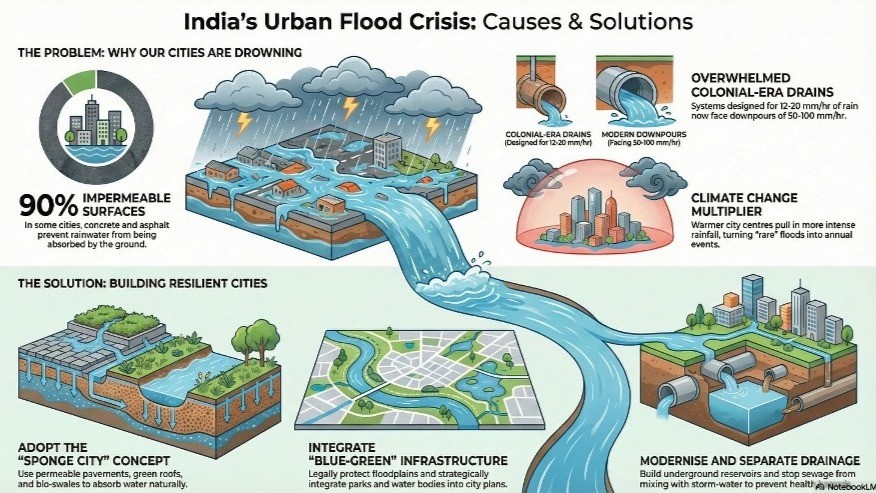
The Indian government is reinforcing its commitment to urban flood management by empowering state governments and local bodies to tackle urban flooding more effectively. Water and sanitation, classified as state subjects, require localized management, especially during periods of heavy rainfall, which contribute significantly to urban flooding.
As a response to the increasing frequency of intense rainfall, which often leads to flooding, the Ministry of Housing and Urban Affairs (MoHUA) has set forth guidelines aimed at improving urban drainage systems. The challenges of urban flooding are exacerbated by unplanned urban growth, encroachment on natural water bodies, and insufficient drainage infrastructure.
Guidelines for Improvement
To address these issues, MoHUA has released several key documents that serve as advisory guidelines. These include the Urban and Regional Development Plans Formulation and Implementation (URDPFI) Guidelines established in 2014, which aim to guide cities in effective urban planning. The Standard Operating Procedure (SOP) for Urban Flooding provides a framework for flood management, while the River Centric Urban Planning Guidelines encourage cities to adopt integrated water management strategies.
Additionally, a Guidance Document on the Creation of Rain Water Harvesting Parks and a Manual on Storm Water Drainage Systems offer practical solutions to help cities mitigate urban flooding while promoting sustainability.
Atal Mission for Rejuvenation and Urban Transformation (AMRUT)
Further reinforcing these efforts, the Atal Mission for Rejuvenation and Urban Transformation (AMRUT) was launched in 2015, specifically aiming to enhance storm water drainage systems. Under this initiative, states and union territories have initiated 838 storm water drainage projects, investing ₹3,022.39 crore to reduce flooding impacts and create green spaces.
In total, 2,522 projects focused on creating green spaces have been undertaken, totaling ₹1,604.13 crore and resulting in the development of approximately 5,400 acres of permeable green areas in various urban spaces.
AMRUT 2.0 and Future Initiatives
Building on the achievements of the original AMRUT, the AMRUT 2.0 program is set to expand on the rejuvenation of water bodies and the development of green spaces. Thus far, proposals have been approved for 2,951 water body rejuvenation projects, with an impressive total funding of ₹6,003.34 crore aiming to cover over 121,000 acres. Furthermore, 1,649 green spaces and parks projects valued at ₹1,087.12 crore are also in motion.
Alongside these projects, AMRUT and AMRUT 2.0 have addressed issues related to sewerage and septage management. Currently, 888 projects have been established, expanding the sewer network by approximately 22,539 kilometers. In the second phase, 605 additional projects have been initiated, further increasing the sewerage infrastructure to cover 40,021 kilometers.
These comprehensive measures, as reported in the Rajya Sabha by Minister of State Shri Tokhan Sahu, highlight the government’s strategic approach to not only managing urban flooding but also enhancing the overall urban infrastructure in India.
Observer Voice is the one stop site for National, International news, Sports, Editor’s Choice, Art/culture contents, Quotes and much more. We also cover historical contents. Historical contents includes World History, Indian History, and what happened today. The website also covers Entertainment across the India and World.
Follow Us on Twitter, Instagram, Facebook, & LinkedIn

