

Revolutionary Gold-Liquid Crystal Material Promises Future of Optical Technologies


A groundbreaking new gold-liquid crystal hybrid material has been developed, showcasing remarkable stability under high temperature fluctuations and significantly enhanced optical characteristics. This novel material paves the way for advancements in next-generation optical technologies, energy-efficient electronics, and sophisticated sensors, marking a pivotal step forward in materials science.
Nano-soft hybrid materials combine the precision of nanotechnology with the adaptability of soft matter, creating a surge in demand for innovative electro-optical materials. A team of researchers from the Centre for Nano and Soft Matter Sciences (CeNS) in Bengaluru, an autonomous institute under the Department of Science and Technology, has achieved this feat. The project, spearheaded by senior scientist Dr. B.L.V. Prasad alongside Ph.D. scholar Muskan Duggal and key contributors Dr. S. Krishna Prasad, Dr. D. S. Shankar Rao, Dr. C.V. Yelamaggad, and Dr. Santosh Khatavi, employed molecular engineering techniques that required minimal processing to produce a high-performance gold liquid crystal (Au-LC) composite.
Innovative Molecular Engineering
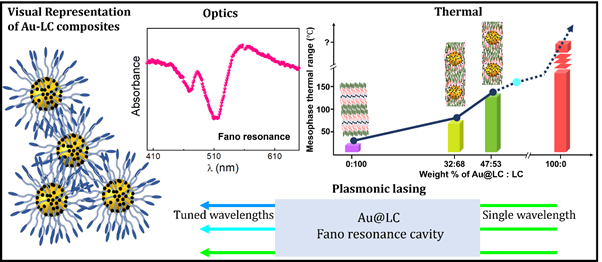
The researchers synthesized an amine-functionalized liquid crystal that served dual purposes: acting as a reducing agent for gold nanoparticles and stabilizing these particles in situ, thus eliminating the need for additional chemicals. This smart approach not only simplified the synthesis process but also granted the researchers significant control over the hybrid material’s structure. As a result, the thermal stability of the composite improved dramatically, increasing from a mere 27 ℃ for pure liquid crystals to an impressive 145 ℃ for the Au-LC hybrid.
Moreover, this innovative design ushered in unique optical characteristics, such as a rare phenomenon known as Fano-like resonance, which holds vast potential for advanced light-based technologies. These advancements could lead to the development of plasmonic lasers, ultrasensitive sensors capable of detecting minute quantities of chemicals or pollutants, and specially designed materials that manipulate light with precision, enabling high-performance optical filters and invisibility cloaks.
Future Implications and Applications
The distinctive optical behaviors exhibited by this new hybrid material suggest a more accessible approach to achieving effects previously reliant on complex systems. The research team’s findings, published in _ACS Applied Nano Materials_, underscore the practical applications of these hybrids, which could facilitate the creation of smarter sensors, adaptive coatings, and next-generation photonic devices with ease and scalability.
As this breakthrough reshapes the landscape of optics, nano-photonics, and biomedical imaging, it signifies a thrilling time for both science and technology, bringing us closer to a future filled with innovative solutions.
Observer Voice is the one stop site for National, International news, Sports, Editor’s Choice, Art/culture contents, Quotes and much more. We also cover historical contents. Historical contents includes World History, Indian History, and what happened today. The website also covers Entertainment across the India and World.

