

Rajnath Singh Reviews Indigenous Aero Engine Development at GTRE

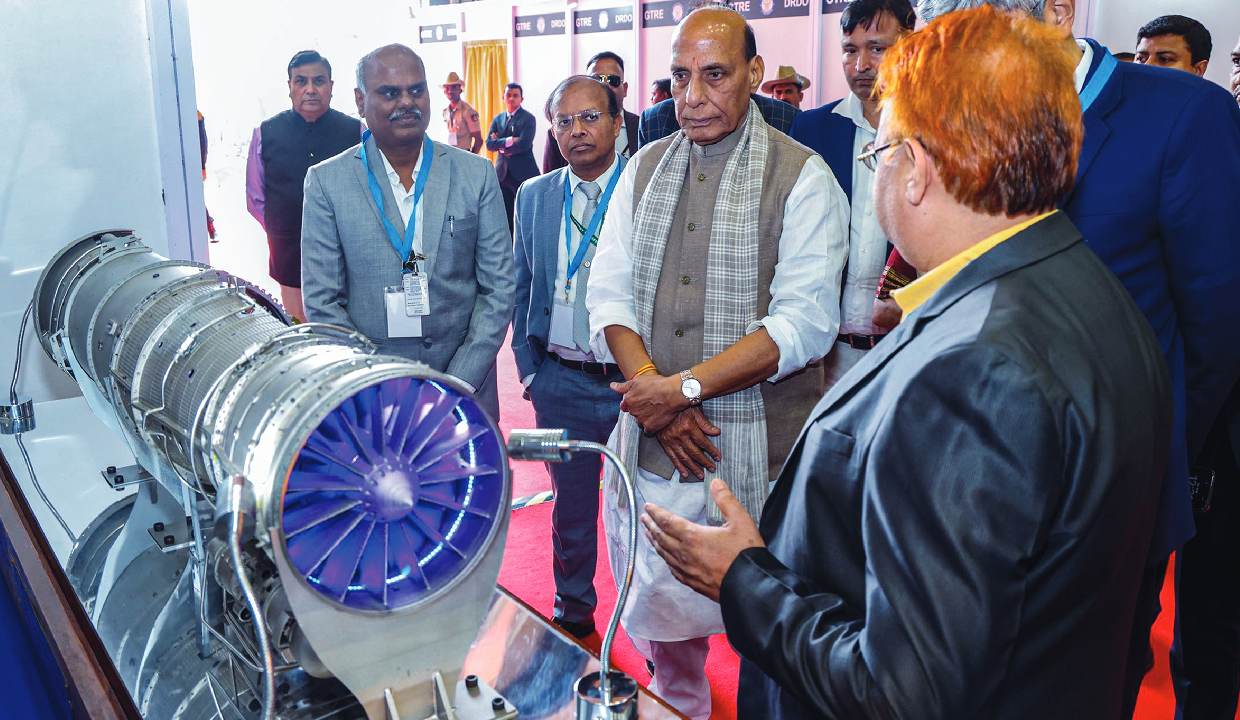
On February 16, 2026, Defence Minister Rajnath Singh visited the Gas Turbine Research Establishment (GTRE) in Bengaluru, where he assessed the progress of projects focusing on the development of indigenous military gas turbine engines. During his visit, he was briefed on various initiatives underway, collaborations with Indian industries, academia, and research institutions, as well as the support being extended to the armed forces. Singh also witnessed an exhibition of homegrown engines and their components, culminating in a full afterburner engine test of the Kaveri engine.
Advancing National Security Through Self-Reliance
During his interaction with scientists and officials at GTRE, Singh commended the establishment’s critical role in enhancing national security through self-reliance. He emphasized the importance of achieving Aatmanirbharta (self-sufficiency) in aero engine technology, particularly in the current fast-paced global environment. “Countries with indigenous critical technologies will ensure their safety and sustainability,” he remarked, reiterating the Indian government’s commitment under Prime Minister Modi to foster self-reliance across multiple sectors.
Focus on Next-Generation Technologies
Singh encouraged GTRE to concentrate on developing next-generation engines by creating a robust ecosystem throughout the country. He noted, “We are swiftly advancing towards the design and development of the Advanced Medium Combat Aircraft (AMCA). Our earlier attempts in this field need to culminate in expertise now. We cannot restrict ourselves to just fifth-generation engines; we must initiate research on sixth-generation technologies immediately.” He pointed out the increasing use of artificial intelligence and machine learning in engine development, stressing the need to stay at the forefront of these advances.
The Complexity of Aero Engine Development
Addressing the technical challenges involved, Singh described aero engine development as a complex task that integrates various scientific and engineering disciplines. He observed that even developed nations require 25-30 years for next-generation engine development, urging Indian scientists to expedite the process in light of the nation’s strategic requirements. “We must act as if 20 years have already passed and we have only 5-7 years remaining,” he added.
Indigenous Defense Innovations and Global Collaborations
Singh highlighted the significance of _Operation Sindoor_, where Indian defence forces showcased the country’s strides towards self-reliance in defense technology. He stated, “Every system, from communication to weaponry, was developed indigenously, uplifting the morale of our soldiers and instilling pride in our citizens.” He also praised GTRE’s partnership with the UK for aero engine development and noted ongoing discussions with France under the National Aero Engine Mission to further enhance capabilities.
Broad Applications of Advanced Technologies
Moreover, Singh outlined the potential dual-use benefits of advanced aero-engine technologies, which could significantly impact sectors like civil aviation, power generation, and space exploration. He mentioned that India is among the fastest-growing civil aviation markets and advancements made in defense aero engines today can transform the aviation landscape tomorrow.
Rising Economic and Political Influence
In his concluding remarks, Singh mentioned the recently finalized free trade agreement between India and the European Union, highlighting it as a testament to India’s rising economic and political clout. He also referred to his recent discussions with Greece’s Defence Minister, who views India as a burgeoning superpower.
Observer Voice is the one stop site for National, International news, Sports, Editor’s Choice, Art/culture contents, Quotes and much more. We also cover historical contents. Historical contents includes World History, Indian History, and what happened today. The website also covers Entertainment across the India and World.

