

NITI Aayog Unveils Key Reports for a Sustainable Viksit Bharat by 2070

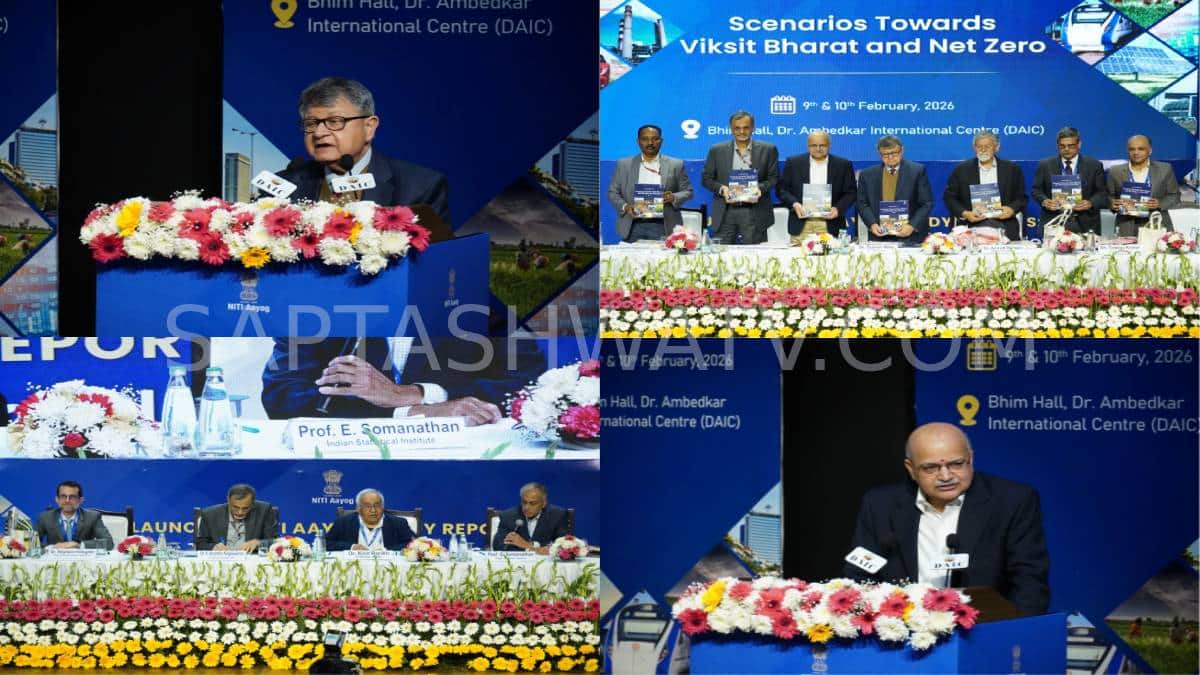
The NITI Aayog has launched eleven pivotal study reports focusing on India’s vision for a developed nation, termed Viksit Bharat, and the pathway to achieving net-zero greenhouse gas emissions by 2070. The final four reports were unveiled at an event at the Ambedkar International Centre in New Delhi, drawing attention to various sectors including buildings, agriculture, waste management, and social implications. This significant release took place on February 10, 2026, in the presence of key officials from NITI Aayog and related governmental bodies.
Among the notable reports released was “Scenarios Towards Viksit Bharat and Net Zero – Sectoral Insights: Buildings (Vol. 5).” This report forecasts that approximately 86% of India’s building floor space expected by 2070 remains to be constructed. It emphasizes the need for an approach that utilizes passive design methodologies, energy-efficient appliances, and low-carbon materials to prevent excessive energy consumption and heat stress, especially as air conditioner ownership is projected to rise dramatically from 10% to 80% by 2070.
The report on agriculture, titled “Scenarios Towards Viksit Bharat and Net Zero – Sectoral Insights: Agriculture (Vol. 6),” highlights a transition strategy focused on resource efficiency. The strategy advocates initiatives like micro-irrigation and optimized fertilizer usage that directly improve farmer incomes and enhance soil health before implementing large-scale energy solutions.
Another pivotal report, “Scenarios Towards Viksit Bharat and Net Zero – Sectoral Insights: Waste (Vol. 8),” addresses critical gaps in waste management. It recommends universal collection methods, door-to-door segregation, and the widespread adoption of bio-methanation. By converting waste into resources such as Bio-CNG and compost, the report supports the vision of a circular economy in urban settings.
Additionally, the reports incorporate social dimensions, as explored in “Scenarios Towards Viksit Bharat and Net Zero- Social Implications of Transition (Vol. 11).” This report stresses that the journey towards net-zero emissions is fundamentally a human-centric development initiative, touching upon areas like land use, employment, and public health.
Following the report release, a panel discussion titled “Climate Transition and Social Implications Across Sectors” was held, moderated by Madhav Pai, CEO of the World Resources Institute (WRI) India. Esteemed panelists, including leaders from various sectors, contributed insights on the implications of climate transition.
Dr. Ramesh Chand, a member of NITI Aayog, remarked on the intricate relationship between agriculture and climate change, while Dr. V. K. Paul highlighted the substantial demands placed on land and water amid these transitions. CEO Sh. B.V.R. Subrahmanyam emphasized that India must prepare its building sector for a significant increase in space utilization, advocating for the integration of net-zero objectives from the onset of construction.
The comprehensive assessment conducted by NITI Aayog marks India’s inaugural government-led, multi-sectoral initiative aimed at evaluating development scenarios. This ambitious project aligns with the Prime Minister’s vision for a Viksit Bharat by 2047, while facilitating a tangible reduction in greenhouse gas emissions.
Observer Voice is the one stop site for National, International news, Sports, Editor’s Choice, Art/culture contents, Quotes and much more. We also cover historical contents. Historical contents includes World History, Indian History, and what happened today. The website also covers Entertainment across the India and World.

