

Indonesians Wave White Flags in Protest Amid Frustration Over Delayed Flood Relief Efforts

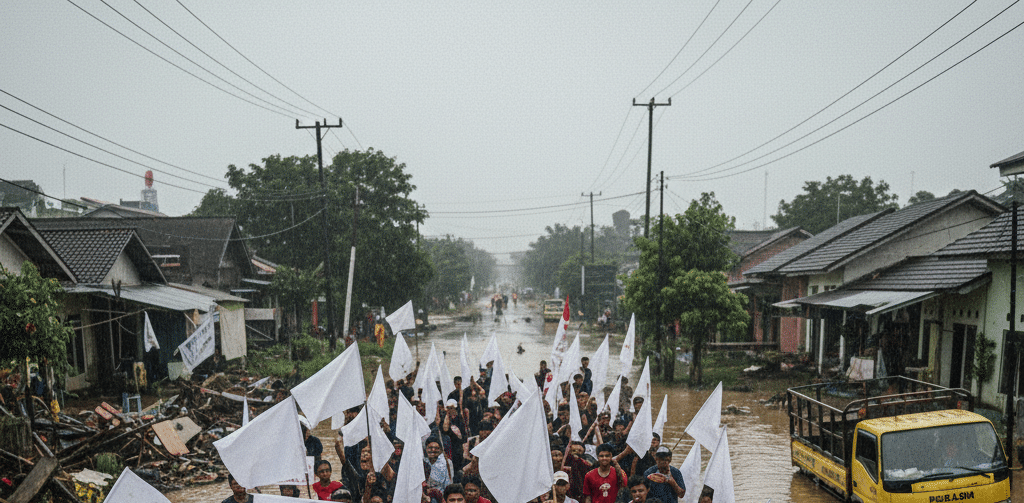
For weeks, residents of Indonesia’s Aceh province have expressed their anger and desperation by raising white flags in response to the government’s inadequate handling of severe flooding. The disaster, triggered by a rare cyclone in November, has resulted in over 1,000 fatalities and left hundreds of thousands displaced across Sumatra. In Aceh, the hardest-hit area, many are still struggling to access essential resources like clean water, food, and medical supplies. Despite the dire situation, President Prabowo Subianto has declined foreign aid, asserting that the crisis is “under control.”
Public Outcry for Assistance
Last Thursday, a significant protest took place in Banda Aceh, where demonstrators waved white flags and called for the central government to accept international aid. Among the protesters was a young girl holding a sign that read, “I am just three years old, I want to grow up in a safe and sustainable world.” The white flags, typically associated with surrender, have been repurposed by the residents as a symbol of distress, aimed at garnering international attention to their plight. Protester Husnul Khawatinnissa emphasized that the flags signal a desperate need for help, stating, “They are a distress signal to grab the attention of friends outside.” The devastation has left entire villages destroyed, with many communities cut off from essential services. Survivors have reported severe shortages of food and clean water, leading to widespread illness and starvation. The Aceh governor has reached out to the United Nations for support, expressing a willingness to accept help from any source.
Echoes of Past Disasters
The recent floods have evoked painful memories for many Acehnese, reminiscent of the catastrophic 2004 Boxing Day tsunami. That disaster, triggered by a massive undersea earthquake, resulted in approximately 230,000 deaths across multiple countries, with Aceh being one of the hardest-hit regions. Locals recall how they had only recently begun to rebuild their lives when the floods struck in November. Many residents feel that the response to the current crisis has been slower and less effective compared to the immediate international aid that followed the tsunami. Rindu Majalina, a survivor, noted that the community recovered quickly after the tsunami, whereas the current situation feels far worse. She described the struggle to feed her children amidst the ongoing crisis, highlighting the desperation felt by many in the region.
Government Response and Criticism
President Prabowo Subianto’s administration has faced increasing criticism for its handling of the flood crisis. Critics describe the government’s response as reactive and disorganized, reflecting a broader perception of the administration as out of touch with the needs of the people. Despite these challenges, Prabowo maintains a steady approval rating of around 78%. His refusal to accept foreign aid is seen by some as an attempt to assert authority and avoid external scrutiny. Political analysts suggest that this approach may backfire, as it prioritizes the “symbolic performance of sovereignty” over effective crisis management. Furthermore, the government’s focus on expanding palm oil plantations has drawn ire from environmental groups, who argue that such actions have exacerbated the flooding. As the situation continues to unfold, many residents like Rindu Majalina express their frustration, stating that the post-disaster conditions are proving to be even more challenging than the initial disaster itself.
Observer Voice is the one stop site for National, International news, Sports, Editor’s Choice, Art/culture contents, Quotes and much more. We also cover historical contents. Historical contents includes World History, Indian History, and what happened today. The website also covers Entertainment across the India and World.

