

NAMASTE Initiative Aims to Protect Sewer Workers Nationwide

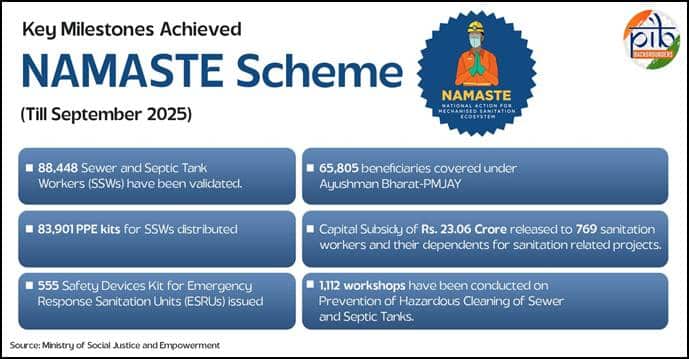
A nationwide survey involving over 4,800 Urban Local Bodies (ULBs) has been executed as part of the NAMASTE scheme, focusing on the identification of Sewer and Septic Tank Workers (SSWs). This initiative is not related to identifying manual scavengers, as clarified by the National Commission for Safai Karamcharis (NCSK).
Since 2019, a concerning statistic has emerged: 471 sanitation workers have tragically lost their lives while cleaning sewers and septic tanks, according to NCSK reports up until October 31, 2025. Families of these deceased workers have received compensation, with 397 families receiving full and 19 families receiving partial support.
The “Prohibition of Employment as Manual Scavengers and their Rehabilitation Act, 2013” strictly forbids hazardous cleaning of sewers and septic tanks. In response, the Department of Social Justice and Empowerment, in collaboration with the Ministry of Housing and Urban Affairs, initiated the NAMASTE scheme for the 2023-24 period. This program aims to establish a safer working environment and uphold the dignity of SSWs, all while ensuring zero fatalities in sanitation labor.
Key Measures Under the NAMASTE Scheme
The NAMASTE scheme focuses on eradicating manual cleaning practices by promoting mechanization in sanitation work. Key steps being implemented include:
- Provision of safety devices for Emergency Response Sanitation Units (ERSUs).
- Upfront capital subsidies for sanitation workers and Private Sanitation Service Operators (PSSOs) to acquire essential cleaning machinery.
- Occupational safety training for sewer and septic tank workers.
- Workshops aimed at reducing hazardous cleaning practices.
Expanding Sanitation Efforts
On October 1, 2021, the Ministry of Housing and Urban Affairs launched the Swachh Bharat Mission – Urban (SBM-U) 2.0. This initiative introduced a component for Used Water Management (UWM), with goals that include eliminating hazardous entries into sewers and septic tanks through mechanized solutions.
To ensure safe practices, the Ministry has issued multiple advisories, including:
- Standard Operating Procedures for sewer and septic tank cleaning.
- Guidelines for safety during cleaning by ERSUs.
- A Ready Reckoner for ULBs to protect sanitation workers.
- Nationwide health check-up camps for sanitation workers organized by ULBs.
- Protocols for ensuring the safety of Safai Mitras.
Support for Affected Workers
The NAMASTE scheme has absorbed components from the former Self-Employment Scheme for the Rehabilitation of Manual Scavengers, providing much-needed rehabilitation assistance. Key figures include:
| Component | Number of Beneficiaries |
|---|---|
| Onetime Cash Assistance | 58,098 |
| Skill Development Training | 27,928 |
| Capital Subsidy for Self-Employment Projects | 2,652 |
Currently, there are no plans to amend the Prohibition of Employment as Manual Scavengers and their Rehabilitation Act, 2013. This information was shared by the Union Minister of State for Social Justice and Empowerment, Shri Ramdas Athawale, in a written response during a Lok Sabha session.
Observer Voice is the one stop site for National, International news, Sports, Editor’s Choice, Art/culture contents, Quotes and much more. We also cover historical contents. Historical contents includes World History, Indian History, and what happened today. The website also covers Entertainment across the India and World.
Follow Us on Twitter, Instagram, Facebook, & LinkedIn

