

Pinkfong’s Journey: How a South Korean Company Transformed a Children’s Jingle into a $400 Million Empire

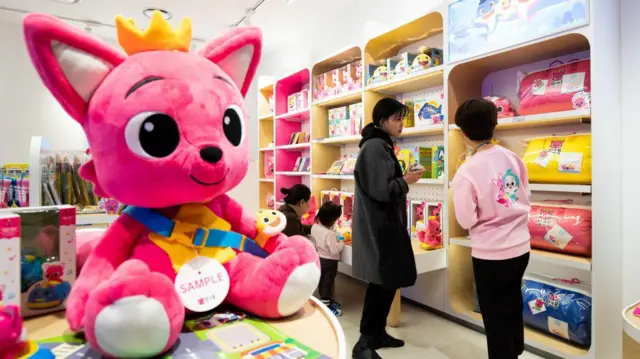
Can a simple children’s song truly evolve into a company valued at over $100 million? This remarkable journey belongs to South Korea’s Pinkfong, a digital content startup that began with just three employees in a tiny office. In less than a decade, Pinkfong has transformed into a major player in the entertainment industry, recently listing its shares on South Korea’s stock market and achieving a valuation exceeding $400 million. The catalyst for this success? The viral sensation “Baby Shark,” a 90-second video that has captivated audiences worldwide.
A Song Older Than the Company Itself
While Pinkfong’s version of “Baby Shark” became a global phenomenon, the melody itself has roots that trace back to summer camps in the United States during the 1970s. Media analyst Kevin Chew notes that the song’s repetitive and catchy lyrics make it appealing to children, even if they can be somewhat grating for adults. Kim Min-seok, one of Pinkfong’s founders, acknowledges the song’s unique charm, likening its addictive quality to that of K-pop music. He believes the rhythmic and chant-like nature of the tune makes it easy for young children to remember and sing along.
The Baby Shark Effect
The rise of “Baby Shark” was not instantaneous. Its popularity surged after children began performing the accompanying dance at events throughout Southeast Asia. As videos of these performances circulated online, the view count skyrocketed. Kim recalls the atmosphere in the Pinkfong office transforming overnight into a celebratory environment as they witnessed the numbers climb in real time. By November 2020, “Baby Shark” had become the most viewed video on YouTube, generating approximately half of Pinkfong’s total revenue. This success prompted the company to expand its character lineup, merchandise, and content offerings.
Growing Pains and Legal Battles
With success came challenges. In 2019, Pinkfong faced a plagiarism accusation from an American composer, who claimed that the company’s rendition of “Baby Shark” was not original. Pinkfong defended its version by asserting that it was based on a public-domain folk song. Ultimately, South Korea’s Supreme Court dismissed the claim, a decision that Kim described as uplifting. Notably, Pinkfong had already submitted its stock listing application prior to the court’s ruling.
What Lies Ahead for Pinkfong
Today, Pinkfong has expanded significantly from its humble beginnings, employing around 340 people and operating offices in Tokyo, Shanghai, and Los Angeles. In 2022, the company rebranded itself as The Pinkfong Company, named after its cheerful pink fox character. However, the firm now faces the challenge of proving that it is not merely a one-hit wonder. Experts suggest that its focus on toddlers, who often watch the same content repeatedly, may provide a competitive edge. Currently, “Baby Shark” accounts for about 25% of Pinkfong’s revenue, while another franchise, Bebefinn, contributes roughly 40%. As the company moves forward, it plans to utilize the nearly $52 million raised from its stock market debut to expand its character offerings and films, aiming to become a tech-driven creator that leverages viewing data to inform its projects.
Observer Voice is the one stop site for National, International news, Sports, Editor’s Choice, Art/culture contents, Quotes and much more. We also cover historical contents. Historical contents includes World History, Indian History, and what happened today. The website also covers Entertainment across the India and World.
Follow Us on Twitter, Instagram, Facebook, & LinkedIn

