

William Penn: Founder of Pennsylvania and Quaker Visionary

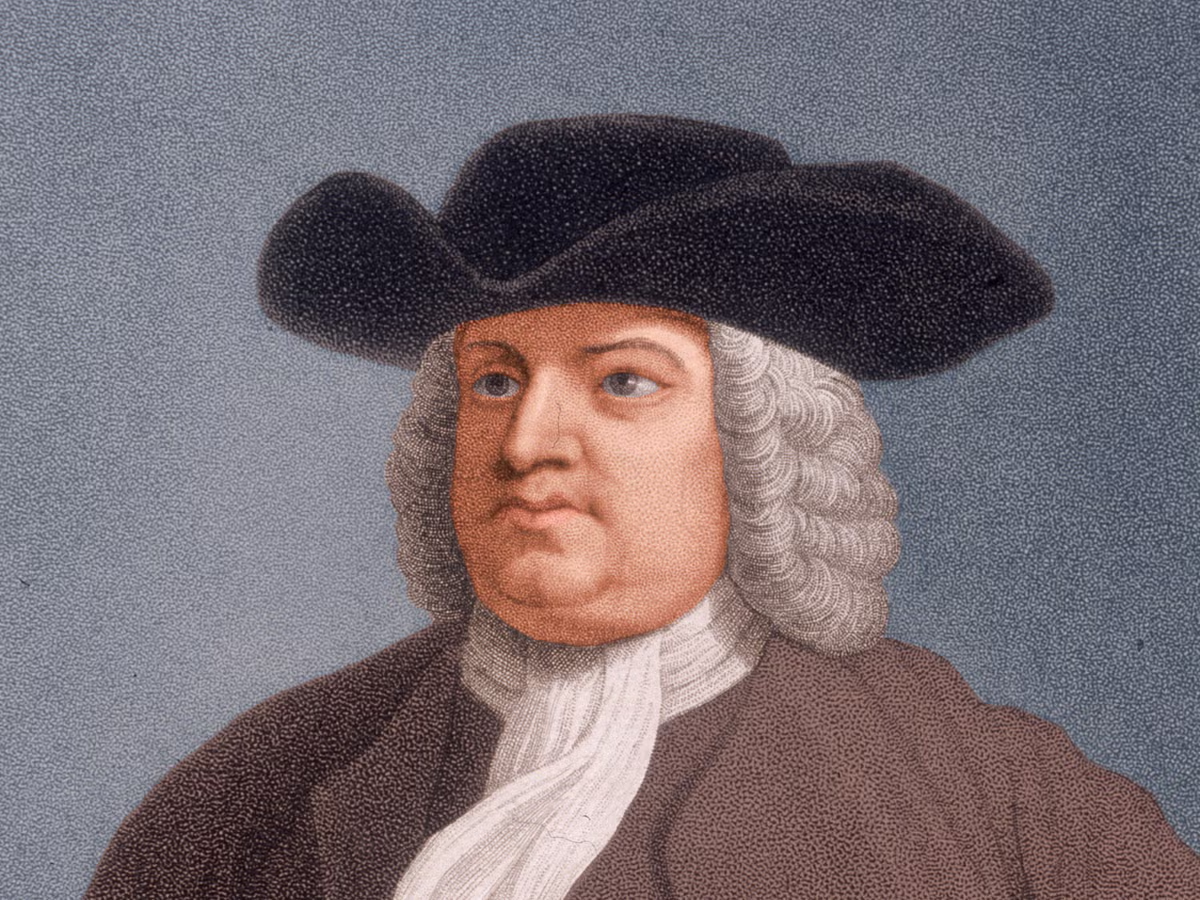
William Penn (24 October 1644 – 10 August 1718) was an English writer, theologian, and influential Quaker who founded the Province of Pennsylvania. He established a territory grounded in Quaker ideals of peace, equality, and representative government that would profoundly influence the founding principles of the United States.
Early Life and Education
Penn was born on 24 October 1644 at Tower Hill, London, the son of Sir William Penn, an English naval officer, and Margaret Jasper, a Dutchwoman and widow of a Dutch sea captain. His father served in the Commonwealth Navy during the Wars of the Three Kingdoms and was later knighted for his role in restoring King Charles II. Young William contracted smallpox, which caused him to lose his hair; he wore wigs for much of his life. The illness prompted his family to move from London to an estate in Essex, where country life made a lasting impression on him and kindled a love of horticulture.
When Penn was about fifteen, his family was exiled to Ireland following his father’s failed Caribbean mission. There he encountered Thomas Loe, a Quaker missionary, whose discourses on the Inward Light profoundly affected the young man. Penn later recalled that “the Lord visited me and gave me divine Impressions of Himself.” After Cromwell’s death and the Royalist resurgence, the family returned to England.
Penn received his early education at Chigwell School and through private tutors in Ireland before attending Christ Church at the University of Oxford. His schooling emphasized classical authors and was conducted in the strict Anglican model typical of the era. Running was his favorite sport, and he often ran more than three miles from his home to school.
Career and Achievements
Penn’s life took a decisive turn when he was expelled from the University of Oxford in 1662 for religious nonconformity. This early break with institutional authority became central to his identity. He embraced Quakerism and dedicated himself to defending freedom of conscience and challenging the established Church of England’s restrictions on religious dissent. He was imprisoned several times in the Tower of London for his faith.
In 1681, King Charles II granted Penn an area of land corresponding to present-day Pennsylvania and Delaware to offset debts owed to Penn’s father. The following year, Penn left England and sailed up Delaware Bay and the Delaware River, where he founded Philadelphia on the river’s western bank. He developed the territory as a Quaker commonwealth emphasizing peace, equality, and economic opportunity alongside representative government. In 1704, the three southernmost counties of Pennsylvania were granted permission to form the semi-autonomous Delaware Colony.
As one of the earliest supporters of colonial unification, Penn wrote and urged the union of all British colonies. The democratic principles he included in the West Jersey Concessions and outlined in the Pennsylvania Frame of Government inspired delegates to the 1787 Constitutional Convention when they drafted the Constitution of the United States. Penn was also known for his amicable relations and successful treaties with the Lenape native peoples who had resided in Pennsylvania before European colonization.
Notable Events and Milestones
Penn authored numerous works exhorting believers to adhere to the spirit of Primitive Christianity. His book No Cross, No Crown, published in 1669 while he was imprisoned in the Tower of London, became a classic of Christian theological literature. His expulsion from Oxford in 1662 marked the beginning of his life outside conventional institutions, where he combined religious leadership, writing, political advocacy, and practical enterprise.
Penn’s founding of Philadelphia in 1682 represented the practical realization of his Quaker ideals. The city became a beacon of religious tolerance and democratic governance in colonial America. His vision of Pennsylvania as a “holy experiment” demonstrated that a territory could be governed according to principles of peace and equality rather than coercion and hierarchy.
Awards and Honors
Penn’s legacy is commemorated at Christ Church, Oxford, where his portrait is displayed in the dining hall. His influence on American constitutional thought and his pioneering advocacy for religious freedom and democratic governance secured his place as a foundational figure in the history of the United States.
Additional Resources
For readers seeking deeper knowledge of William Penn’s life and legacy, comprehensive biographical information is available through Wikipedia and other historical archives. His writings, particularly No Cross, No Crown and the Pennsylvania Frame of Government, remain accessible to scholars and students interested in the intellectual foundations of American democracy and Quaker theology.
Observer Voice is the one stop site for National, International news, Sports, Editor’s Choice, Art/culture contents, Quotes and much more. We also cover historical contents. Historical contents includes World History, Indian History, and what happened today. The website also covers Entertainment across the India and World.

