

Subroto Mukerjee: Father of the Indian Air Force

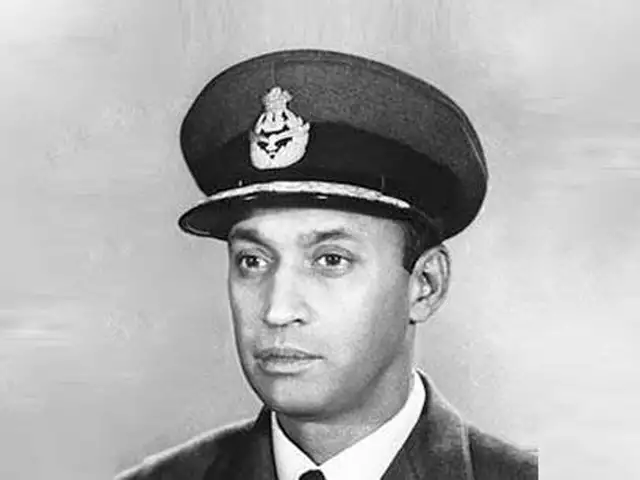
Subroto Mukerjee (5 March 1911 – 8 November 1960) was an Indian military officer who served as the first Indian Commander-in-Chief of the Indian Air Force. He has been called the “Father of the Indian Air Force” and oversaw its transformation into an all-jet force during his tenure.
Early Life and Education
Mukerjee was born in Calcutta on 5 March 1911 into a well-known Bengali Brahmo family. His father, Satish Chandra Mukherjee, served in the Indian Civil Service, and his mother, Charulata Mukherjee, was a social worker. His paternal grandfather, Nibaran Chandra Mukherjee, pioneered social and educational reforms and was a member of the Brahmo Samaj. His maternal grandfather, Prasanna Kumar Roy, was the first Indian Principal of Presidency College, Kolkata, and his maternal grandmother, Sarala Roy, founded the Gokhale Memorial Girls’ School.
Though taken to England at three months old, Mukerjee spent his childhood in Krishnanagar and Chinsura in Bengal. His uncle, Flight Lieutenant Indra Lal Roy, was the first Indian to be awarded the Distinguished Flying Cross and the only Indian flying ace, likely influencing Mukerjee’s military aspirations. His elder sister, Renuka Ray, became a prominent freedom fighter, member of parliament, cabinet minister, and ambassador. Mukerjee was educated at Nainital Diocesan Boys’ High School (later Sherwood College), Loreto Convent in Calcutta, Howrah Zilla School, a school in Hampstead, and Birbhum Zilla School, completing his secondary education in 1927. He then attended Presidency College, Calcutta for a year before studying at the University of Cambridge.
Career and Achievements
In 1928, Mukerjee was selected as one of the first six Indians permitted to enter the Royal Air Force College Cranwell. After completing his training there, he received further instruction at the Army Cooperation School at Old Sarum Airfield in Wiltshire and served with No. 16 Squadron RAF before returning to India. On 1 April 1933, he became one of five Indian pilots in “A” Flight of No. 1 Squadron IAF at Drigh Road in Karachi. He was promoted to flying officer on 15 February 1934.
During the 1936 rebellion in the North-West Frontier Province, Mukerjee saw extensive action and was awarded the India General Service Medal with clasps for ‘North West Frontier 1936–37’ and ‘North West Frontier 1937–39’. In July 1938, he took command of “B” Flight of No. 1 Squadron, and on 16 March 1939, he became the first Indian officer to command a squadron. He was promoted to flight lieutenant on 15 February 1939.
During World War II, Mukerjee was promoted to acting squadron leader on 25 August 1939. On 7 August 1940, he and his gunner removed ammunition from a Lewis machine gun and dropped it in socks to a besieged army picket under concentrated fire. In June 1941, he handed over command of No. 1 Squadron and attended the Staff College, Quetta. He returned to command the squadron for a second time in March 1942. In December 1942, he was mentioned in dispatches for distinguished service during operations in the NWFP. From 28 August 1943 to December 1944, he commanded RAF Station Kohat, becoming the first Indian officer to command an airbase. He was appointed director of flying training at Air Headquarters and awarded the OBE in June 1945.
On 15 May 1947, as the most senior Indian officer in the Royal Indian Air Force, Mukerjee was promoted to acting air commodore and became the first Indian air officer. Following Partition on 15 August 1947, he was appointed Senior Air Staff Officer and Deputy Air Commander of the RIAF. During the Indo-Pakistani War of 1947, he was promoted to acting air vice marshal on 15 November 1947. On 15 March 1948, he took over as officiating chief of the air staff and air marshal commanding RIAF, serving for about a year. In September 1948, he controlled air operations during India’s police action against Hyderabad State. After attending the Imperial Defence College in 1953, he was appointed Commander-in-Chief of the IAF in 1954. From 1955, he also served as Chairman of the Chiefs of Staff Committee.
Notable Events and Milestones
Mukerjee achieved several historic firsts: the first Indian to command a flight in 1938, the first Indian to command a squadron in 1939, the first to command an airbase in 1943, and the first Indian to command the Indian Air Force itself in 1954. He died on 8 November 1960 while on a visit to Tokyo. His accidental death shocked the Air Force and the nation, and he was cremated with full military honours in New Delhi.
Awards and Honors
Mukerjee was awarded the India General Service Medal with clasps for service in the North-West Frontier Province in 1936–37 and 1937–39. He was appointed an Officer of the Order of the British Empire (OBE) in June 1945.
Additional Resources
For further reading on Subroto Mukerjee and the history of the Indian Air Force, consult biographical works and official IAF records documenting his pioneering role in establishing India’s air defence capabilities.
Observer Voice is the one stop site for National, International news, Sports, Editor’s Choice, Art/culture contents, Quotes and much more. We also cover historical contents. Historical contents includes World History, Indian History, and what happened today. The website also covers Entertainment across the India and World.

