

Salvador Allende: Chile’s Socialist President

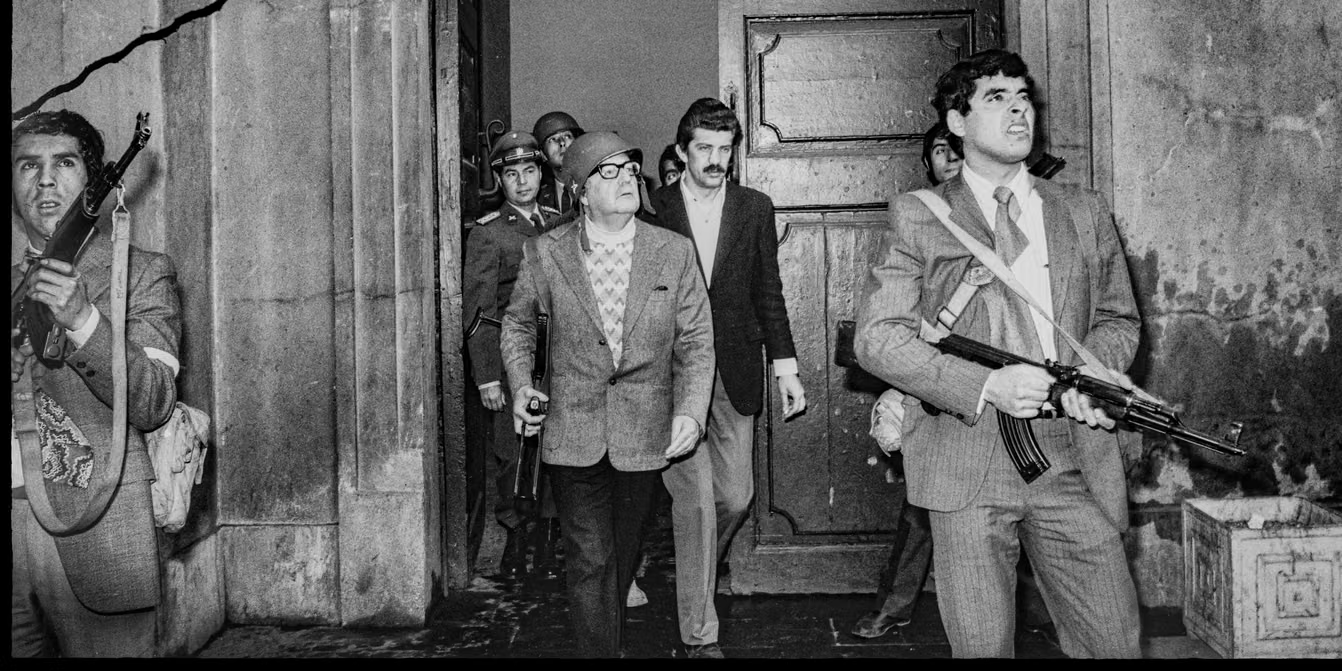
Salvador Allende (26 June 1908 – 11 September 1973) was a Chilean socialist politician who served as the 29th president of Chile from 1970 until his death in 1973. He was the first Marxist to be elected president in a liberal democracy in Latin America.
Early Life and Education
Allende was born on 26 June 1908 in Santiago to Salvador Allende Castro and Laura Gossens Uribe. His family belonged to the Chilean upper middle class with a tradition of progressive political involvement; his grandfather was a prominent physician and social reformist who founded one of Chile’s first secular schools. Allende was of Basque and Belgian descent. In 1909, he moved with his family to Tacna, then under Chilean administration, and later to Iquique in 1916. He attended the National Institute of Santiago starting in 1918, then studied at the Liceo de Valdivia from 1919 to 1921, and the Eduardo de la Barra school from 1922 to 1924.
As a teenager, Allende was intellectually influenced by Juan De Marchi, an Italian-born anarchist shoemaker. He was also a talented athlete, joining the Everton de Viña del Mar sports club. In 1926, at age 18, he began studying medicine at the University of Chile in Santiago, where he was elected President of the Student Center in 1927. During medical school, he was shaped by Professor Max Westenhofer, a German pathologist who emphasized social determinants of disease and social medicine. Allende graduated at age 23 in 1931 and began practicing as a physician and anatomo-pathologist at Van Buren Hospital in 1932.
Career and Achievements
Allende’s political career began in earnest in the early 1930s. In 1933, he co-founded a section of the Socialist Party of Chile in Valparaíso with Marmaduque Grove and others, becoming its chairman. That year he married Hortensia Bussi, with whom he had three daughters. In 1937, he was elected Deputy of Valparaíso and Aconcagua, and in 1938 he served as Undersecretary General of the Socialist Party of Chile. He also managed the electoral campaign of the Popular Front headed by Pedro Aguirre Cerda in 1938, and after its victory became Minister of Health in the resulting government.
Allende remained active in Chilean politics for nearly forty years, holding positions as senator, deputy, and cabinet minister. He was a lifelong committed member of the Socialist Party of Chile, to whose foundation he had actively contributed. He ran unsuccessfully for the national presidency in 1952, 1958, and 1964 before winning the presidency in 1970 as the candidate of the Popular Unity coalition in a close three-way race. He was elected in a Congressional run-off, as no candidate had gained a majority.
Notable Events and Milestones
As president, Allende pursued what he called “The Chilean Path to Socialism.” He sought to nationalize major industries, expand education, and improve the living standards of the working class. His coalition government was internally divided: Allende represented the more moderate faction of the Socialist Party committed to democracy, while the radical wing sought a more radical course. The Communist Party of Chile favored a gradual and cautious approach seeking cooperation with Christian democrats, an influence that proved significant for the Italian Communist Party’s Historic Compromise strategy.
Allende clashed with right-wing parties that controlled Congress and with the judiciary. On 11 September 1973, the Chilean military moved to oust his democratically elected government in a coup d’état supported by the CIA. Declassified documents revealed that US President Richard Nixon and National Security Advisor Henry Kissinger were aware of the military’s plans to overthrow Allende in the days before the coup. As troops surrounded La Moneda Palace, Allende delivered his final speech vowing not to resign. Later that day, he died by suicide in his office; the exact circumstances remain disputed.
Following Allende’s death, General Augusto Pinochet refused to return authority to a civilian government. The military junta dissolved Congress, suspended the Constitution of 1925, and initiated a program of persecuting alleged dissidents in which at least 3,095 civilians disappeared or were killed. Pinochet’s military dictatorship ended only after the successful 1989 constitutional referendum led to Chile’s peaceful transition to democracy, ending more than four decades of uninterrupted democratic governance known as the Presidential Republic.
Additional Resources
Allende’s life and presidency remain subjects of significant historical study and debate. Readers seeking more detailed information about his early medical career, his various political campaigns, the policies of his government, and the circumstances surrounding his death can consult comprehensive biographical sources and historical archives, including Wikipedia and academic works on Chilean history and Latin American politics.
Observer Voice is the one stop site for National, International news, Sports, Editor’s Choice, Art/culture contents, Quotes and much more. We also cover historical contents. Historical contents includes World History, Indian History, and what happened today. The website also covers Entertainment across the India and World.
Follow Us on Twitter, Instagram, Facebook, & LinkedIn

