

Oswald Avery: Pioneer of Molecular Biology

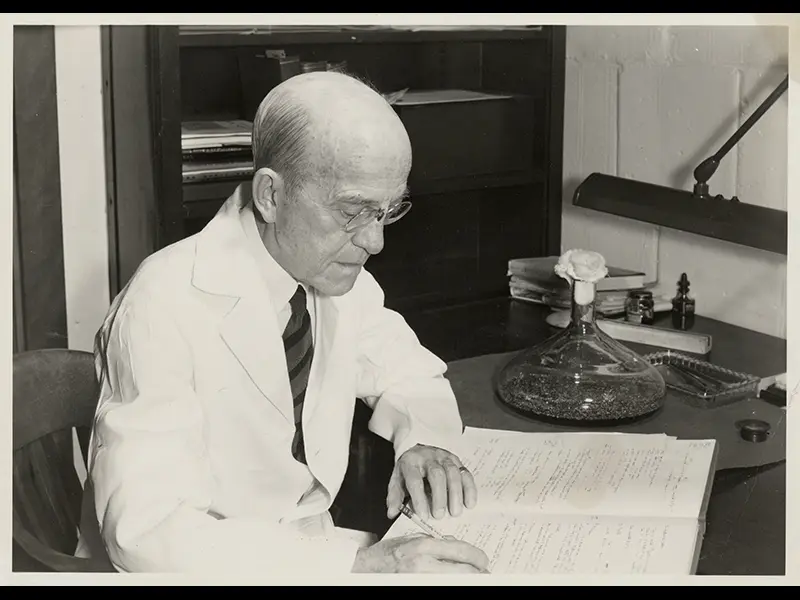
Oswald Theodore Avery Jr. (October 21, 1877 – February 20, 1955) was a Canadian-American physician and medical researcher. He is best known for the 1944 experiment that identified DNA as the material of which genes and chromosomes are made.
Early Life and Education
Oswald Avery was born in Halifax, Nova Scotia, to Joseph Francis Avery, a Baptist minister, and Elizabeth Crowdy. The family had emigrated from Britain in 1873 and lived in a small wooden row house on Moran Street in Halifax’s North End. When Avery was ten, his family moved to the Lower East Side of New York City.
As a boy, Avery learned to play the cornet from a German musician at his church and became skilled enough to perform with the National Academy of Music under Walter Damrosch in Antonín Dvořák’s Symphony No. 5, From the New World. He earned a scholarship to the National Conservatory of Music. Beginning in 1896, he attended Colgate University, where he excelled in public speaking and humanities, earning his undergraduate degree in 1900. He then enrolled at The College of Physicians and Surgeons at Columbia University in New York, graduating with a medical degree in 1904.
Career and Achievements
After graduating from medical school, Avery practiced general medicine briefly but found the work unsatisfying, particularly his inability to treat chronic diseases. In 1907, he joined Hoagland Laboratory as an associate director under Benjamin White, marking his transition to research.
At Hoagland Laboratory, Avery began studying the bacteriology of yogurt and fermented milk products and their effects on gut bacteria, publishing his findings in “Observations on Certain Lactic Acid Bacteria of the Bulgaricus Type.” Between 1909 and 1913, he conducted medical research using immunological and chemical approaches. When White contracted tuberculosis, Avery accompanied him to Trudea Sanatorium and subsequently became interested in tuberculosis research himself, conducting clinical and experimental studies at Trudea Laboratory.
The major portion of Avery’s career was spent at the Rockefeller Hospital in New York City, where he became one of the first molecular biologists and a pioneer in immunochemistry.
Notable Events and Milestones
Avery’s most significant contribution came in 1944, when he published an experiment with co-workers Colin MacLeod and Maclyn McCarty that isolated DNA as the genetic material of genes and chromosomes. This work fundamentally transformed the understanding of heredity and molecular biology.
Awards and Honors
Despite his groundbreaking contributions, Avery never received the Nobel Prize, though he was nominated throughout the 1930s, 1940s, and 1950s. Nobel laureate Arne Tiselius remarked that Avery was the most deserving scientist not to receive the prize. The lunar crater Avery was named in his honor.
Additional Resources
Avery’s life and work remain central to the history of molecular biology. Readers seeking more detailed information about his research, family background, and scientific legacy can find extensive biographical material in Wikipedia and other scientific archives dedicated to the history of genetics and biochemistry.
Observer Voice is the one stop site for National, International news, Sports, Editor’s Choice, Art/culture contents, Quotes and much more. We also cover historical contents. Historical contents includes World History, Indian History, and what happened today. The website also covers Entertainment across the India and World.
Follow Us on Twitter, Instagram, Facebook, & LinkedIn

