

Lyndon B. Johnson: Architect of the Great Society

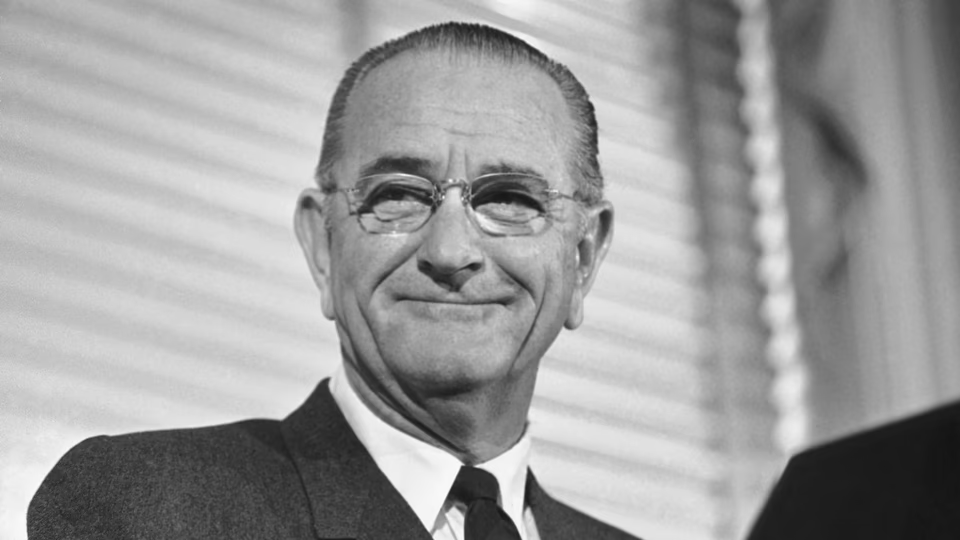
Lyndon Baines Johnson (27 August 1908 – 22 January 1973) was an American politician and the 36th president of the United States. He transformed the domestic landscape through sweeping legislation on civil rights, health care, and education, though his presidency was ultimately shadowed by the Vietnam War.
Early Life and Education
Johnson was born near Stonewall, Texas, in a small farmhouse on the Pedernales River, the eldest of five children born to Samuel Ealy Johnson Jr. and Rebekah Baines. He was not given a name until three months old, as his parents disagreed; he was finally named after a county lawyer, W. C. Linden, though his mother insisted on the spelling “Lyndon.” His family included one brother, Sam Houston Johnson, and three sisters. Through his mother, he was a great-grandson of Baptist clergyman George Washington Baines.
Johnson grew up poor, with his father losing considerable money. Biographer Robert Caro described him as raised “in a land without electricity, where the soil was so rocky that it was hard to earn a living from it.” In school, he was talkative and elected president of his 11th-grade class, graduating in 1924 from Johnson City High School after participating in public speaking, debate, and baseball. He enrolled at Southwest Texas State Teachers College in summer 1924 but left weeks later for California, working at his cousin’s legal practice and in odd jobs before returning to Texas as a day laborer. In 1926, he enrolled at SWTSTC, working his way through school while participating in debate and campus politics and editing the school newspaper, The College Star. From 1928 to 1929, he paused his studies to teach Mexican–American children at the segregated Welhausen School in Cotulla, Texas.
Career and Achievements
Johnson worked as a congressional aide before winning election to the U.S. House of Representatives in 1937, representing Texas as a Democrat. In 1948, he was controversially declared the winner in the Democratic primary for the U.S. Senate election in Texas and won the general election. He rose through Senate ranks, becoming Senate majority whip in 1951, Senate Democratic leader in 1953, and majority leader in 1954. When Senator John F. Kennedy secured the 1960 Democratic presidential nomination, he surprised many by offering Johnson the vice presidential slot. The Kennedy–Johnson ticket won the general election, and Johnson served as vice president from 1961 until Kennedy’s assassination in 1963.
Johnson assumed the presidency in November 1963 and won reelection in a landslide in 1964, capturing the largest share of the popular vote for any Democratic candidate in history and the highest for any American presidential candidate in history. His domestic policy agenda, the Great Society, aimed at expanding civil rights, public broadcasting, health care access, education aid, the arts, urban and rural development, consumer protection, environmentalism, and public services. He spearheaded the War on Poverty to create better living conditions for low-income Americans.
Johnson signed the Social Security Amendments of 1965, creating Medicare and Medicaid. He made the Apollo Moon landing program a national priority, enacted the Higher Education Act of 1965 establishing federally insured student loans, and signed the Immigration and Nationality Act of 1965, which laid groundwork for modern U.S. immigration policy. His civil rights legacy rested on the Civil Rights Act of 1964, the Voting Rights Act of 1965, and the Civil Rights Act of 1968. His presidency marked the peak of modern American liberalism in the 20th century.
Notable Events and Milestones
Johnson began his presidency with near-universal support but saw his approval decline as the public grew frustrated with the Vietnam War and domestic unrest, including race riots and a widening credibility gap between his reports and public perception. Crime also increased during his tenure. Initially planning to seek reelection in 1968, Johnson withdrew his candidacy following disappointing results in the New Hampshire primary. He retired to his Texas ranch and maintained a low public profile until his death in 1973.
Awards and Honors
Historians and scholars rank Johnson in the upper tier for his accomplishments regarding domestic policy. His administration enacted several major laws that brought significant changes in civil rights, health care, welfare, and education. However, Johnson is heavily criticized for his foreign policy, particularly for escalating American involvement in the Vietnam War. Public opinion and academic assessments of his legacy have fluctuated greatly since his presidency.
Additional Resources
Johnson’s presidency remains one of the most studied and debated in American history. Readers seeking deeper exploration of his life, policies, and impact can find extensive biographical materials, historical analyses, and primary sources through Wikipedia and other historical archives, including the Lyndon B. Johnson Presidential Library and Museum.
Observer Voice is the one stop site for National, International news, Sports, Editor’s Choice, Art/culture contents, Quotes and much more. We also cover historical contents. Historical contents includes World History, Indian History, and what happened today. The website also covers Entertainment across the India and World.
Follow Us on Twitter, Instagram, Facebook, & LinkedIn

