

Leroy Anderson: Master of Light Orchestral Music

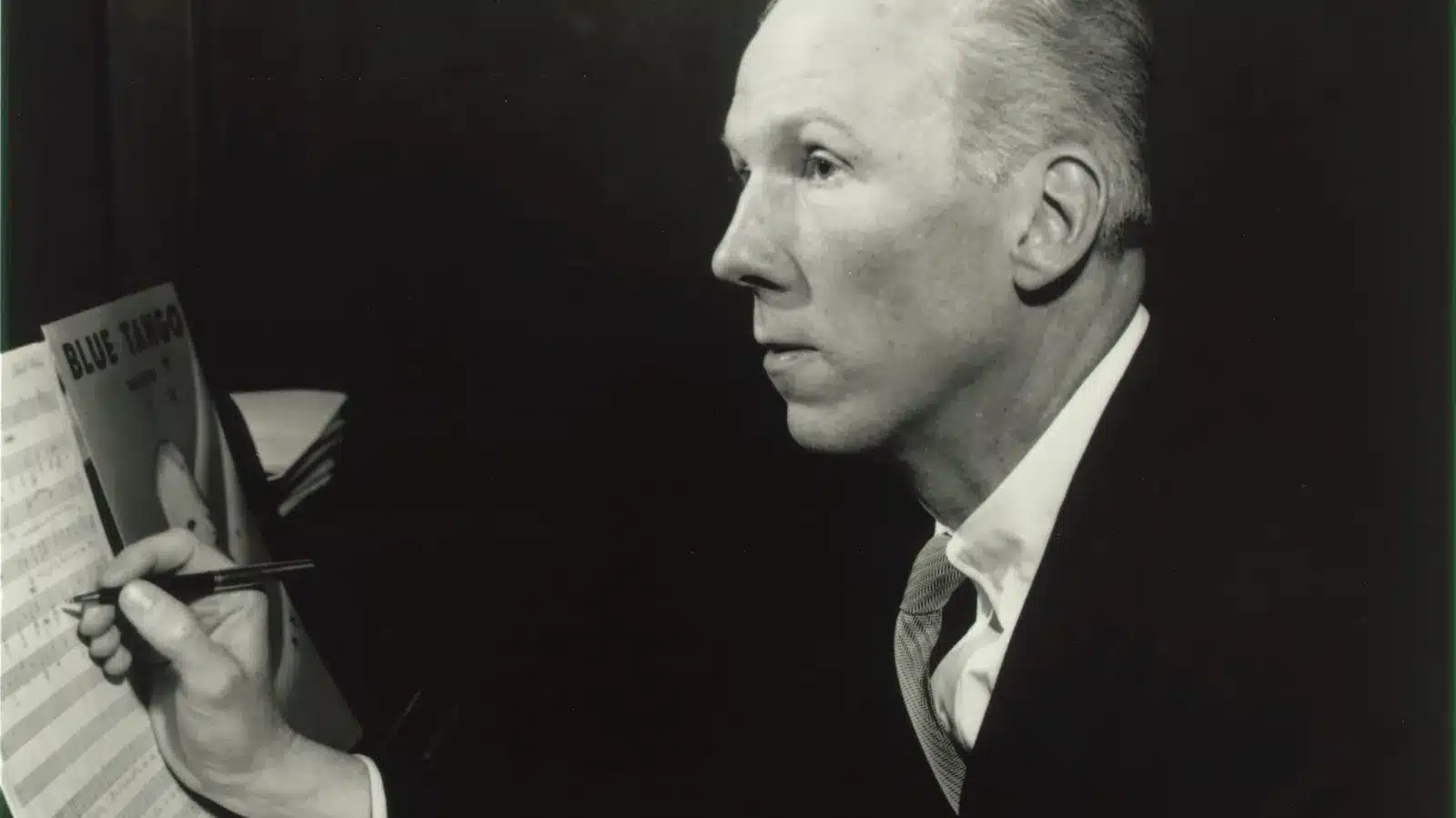
Leroy Anderson (June 29, 1908 – May 18, 1975) was an American composer of short, light concert pieces, many introduced by the Boston Pops Orchestra under Arthur Fiedler. His instrumental compositions became commercial successes in the 1950s, with “Blue Tango” becoming the first instrumental recording to sell one million copies.
Early Life and Education
Anderson was born in Cambridge, Massachusetts to Swedish parents. His mother, a church organist, gave him his first piano lessons. He studied piano at the New England Conservatory of Music before entering Harvard College in 1925, where he studied harmony, counterpoint, canon and fugue, orchestration, and composition under faculty including Walter Piston and Edward B. Hill. He graduated with a Bachelor of Arts, magna cum laude in 1929 and was elected to Phi Beta Kappa.
At Harvard University Graduate School, Anderson studied composition with Walter Piston and George Enescu, receiving a Master of Arts in Music in 1930. He and his brother played in dance orchestras on Scandinavian cruise ships during the summers of 1930 and 1931. Beyond his native English and Swedish, Anderson eventually became fluent in Danish, Norwegian, Icelandic, German, French, Italian, and Portuguese.
Career and Achievements
In the mid-1930s, Anderson worked as organist and choir director at the East Milton Congregational Church, led the Harvard University Band, and conducted and arranged for dance bands around Boston. In 1936, his arrangements caught the attention of Arthur Fiedler, the conductor of the Boston Pops Orchestra, who invited him to submit original compositions for concert use.
Anderson’s first work for Fiedler was “Jazz Pizzicato” in 1938, a piece just over ninety seconds long. When Fiedler noted it was too short for a three-minute 78 rpm single, Anderson wrote “Jazz Legato” as a companion piece the same year. The combined recording became one of his signature compositions. In 1942, Anderson joined the United States Army and was assigned to Iceland with the U.S. Counterintelligence Corps as a translator and interpreter. In 1945 he was reassigned to the Pentagon as Chief of the Scandinavian Desk of Military Intelligence. Despite military duties, he continued composing, writing “The Syncopated Clock” and “Promenade” in 1945. He later became a reserve officer and was recalled to active duty for the Korean War.
Anderson wrote “Blue Tango” in 1951, which earned a Golden Disc and reached No. 1 on the Billboard charts. His recordings during the 1950s conducting a studio orchestra achieved immense commercial success. “Sleigh Ride,” one of his most famous pieces, was not originally written as a Christmas composition but as a work describing a winter event; Anderson started it during a heat wave in August 1946. The Boston Pops’ recording of “Sleigh Ride” was the first pure orchestral piece to reach No. 1 on the Billboard Pop Music chart.
Anderson’s musical style employed creative instrumental effects and occasionally used sound-generating items such as typewriters and sandpaper. In 1958, he composed the music for the Broadway show “Goldilocks” with orchestrations by Philip J. Lang. Though it earned two Tony awards, the show did not achieve commercial success, and Anderson never wrote another musical, preferring to continue with orchestral miniatures. His pieces including “The Typewriter,” “Bugler’s Holiday,” and “A Trumpeter’s Lullaby” became standards performed by orchestras and bands from school groups to professional organizations.
Notable Events and Milestones
In February 1951, WCBS-TV in New York City selected “The Syncopated Clock” as the theme song for “The Late Show,” the station’s late-night movie program. Mitchell Parish added lyrics to “The Syncopated Clock” and later wrote lyrics for other Anderson compositions including “Sleigh Ride.” From 1952 to 1961, Anderson’s composition “Plink, Plank, Plunk!” served as the theme for the CBS panel show “I’ve Got a Secret.”
Anderson wrote his Piano Concerto in C in 1953 but withdrew it, feeling it had weak spots. The Anderson family decided to publish the work in 1988, and Erich Kunzel and the Cincinnati Pops Orchestra released the first recording. On May 18, 1972, Anderson appeared with the Boston Pops in a performance broadcast by PBS, conducting “The Typewriter” as an encore while Arthur Fiedler played the carriage return percussive part. The Boston Pops later used audio and video from that performance in a tribute film to Fiedler.
Awards and Honors
Anderson was initiated as an honorary member of the Gamma Omega chapter of Phi Mu Alpha Sinfonia at Indiana State University in 1969. He was posthumously inducted into the Songwriters Hall of Fame in 1988. In 1995, the new headquarters of the Harvard University Band was named the Anderson Band Center in his honor. Anderson received a star on the Hollywood Walk of Fame at 1620 Vine Street for his contribution to the recording industry.
Additional Resources
Leroy Anderson’s life and work are documented in greater detail through Wikipedia and other biographical archives. His compositions remain central to the repertoire of pops orchestras worldwide, and recordings of his pieces continue to be released by major orchestras and conductors.
Observer Voice is the one stop site for National, International news, Sports, Editor’s Choice, Art/culture contents, Quotes and much more. We also cover historical contents. Historical contents includes World History, Indian History, and what happened today. The website also covers Entertainment across the India and World.

