

India’s Climate Action Plan Draws Criticism at UN Summit for Delayed Implementation

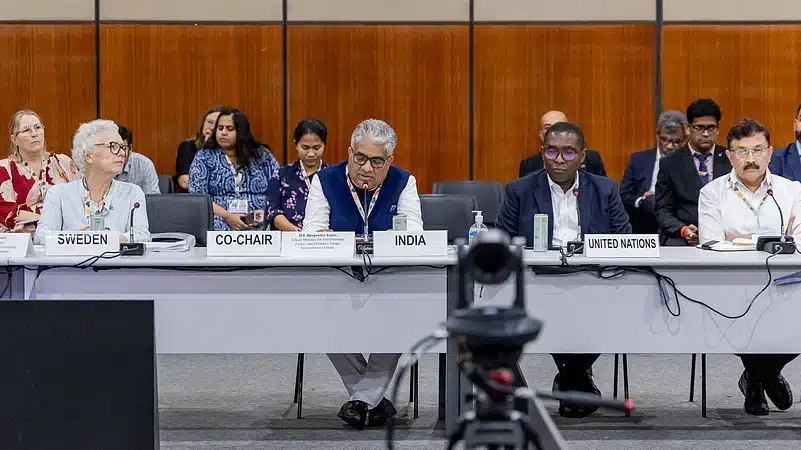
At the ongoing UN climate summit (COP30) in Belem, Brazil, India, the world’s third-largest carbon emitter, is under scrutiny for its delayed submission of a crucial climate plan. Despite international assessments labeling India’s climate actions as “worryingly inadequate,” the country maintains a different perspective. As the deadline for updated Nationally Determined Contributions (NDCs) approaches, India is expected to outline its carbon reduction targets by the end of December, raising questions about its commitment to global climate goals.
India’s failure to submit its updated climate plan has drawn attention at COP30, where approximately 120 out of 196 member countries have already done so. The updated NDCs are essential for setting more ambitious carbon reduction targets, especially as the world struggles to meet the goals established in the Paris Agreement. This agreement aims to limit global temperature rise to well below 2 degrees Celsius, with an aspiration of 1.5 degrees Celsius to prevent severe climate impacts. The United Nations Environment Programme (UNEP) has indicated that to align with these goals, annual emissions must decrease significantly by 2035. However, current projections suggest only a 12% reduction, highlighting the urgent need for more robust climate policies.
The initial deadline for the updated NDCs was set for February but was extended to September due to widespread non-compliance among member countries. As COP30 commenced, many nations began submitting their plans, yet India remained silent until Environment Minister Bhupender Yadav announced that the submission would occur by the end of December. This delay raises concerns about India’s climate strategy and its implications for global efforts to combat climate change.
Developing Nations’ Perspective
India’s reluctance to submit a more ambitious climate plan appears rooted in its stance that developed nations should take greater responsibility for emissions reductions and provide substantial financial support to developing countries. Minister Yadav emphasized this viewpoint in an opinion piece prior to COP30, arguing that mere discussions will not suffice to address the climate crisis. He called for immediate action and highlighted the need for developed countries to reach net-zero emissions sooner and to deliver significant climate finance.
Indian officials assert that without adequate financial and technological support from wealthier nations, their updated climate plans would be ineffective. The Paris Agreement mandates developed countries to assist developing nations, but this has been a contentious issue. During the last COP, developing countries expressed frustration over the insufficient climate finance commitments made by wealthier nations, which fell short of the demands for over $1 trillion annually.
India’s Energy Landscape and Challenges
India claims it should not be pressured for a more ambitious climate plan, citing its achievement of having 50% of its installed electricity capacity from non-fossil fuel sources ahead of the 2030 deadline. However, global assessments indicate that India’s reliance on coal remains a significant barrier to meeting climate goals. Currently, coal accounts for approximately 75% of India’s electricity generation, a figure that must decrease to 19% to align with the global target of limiting temperature rise to 1.5 degrees Celsius.
Recent reports have highlighted India’s increasing greenhouse gas emissions, with the country experiencing the highest rise in emissions in 2024 compared to previous years. Despite this, China, often seen as an ally in climate negotiations, has already submitted its updated climate plan, putting additional pressure on India to follow suit. As discussions at COP30 continue, the focus remains on whether India will adjust its climate strategy in response to mounting criticism regarding its coal dependency.
The Road Ahead for India’s Climate Commitments
As COP30 progresses, the international community is keenly awaiting India’s updated climate plan. The country’s commitment to submit its NDC by the end of December is seen as a critical step in addressing global climate challenges. However, the effectiveness of this plan will largely depend on the financial and technological support India receives from developed nations.
The ongoing discussions at COP30 also include the potential for a roadmap to transition away from fossil fuels, a topic that could significantly impact India’s future climate policies. With the world watching closely, it remains to be seen how India’s updated climate plan will reflect its commitment to global climate goals and whether it will address the pressing need for more ambitious carbon reduction targets.
Observer Voice is the one stop site for National, International news, Sports, Editor’s Choice, Art/culture contents, Quotes and much more. We also cover historical contents. Historical contents includes World History, Indian History, and what happened today. The website also covers Entertainment across the India and World.
Follow Us on Twitter, Instagram, Facebook, & LinkedIn

