

Gideon Welles: Lincoln’s Secretary of the Navy

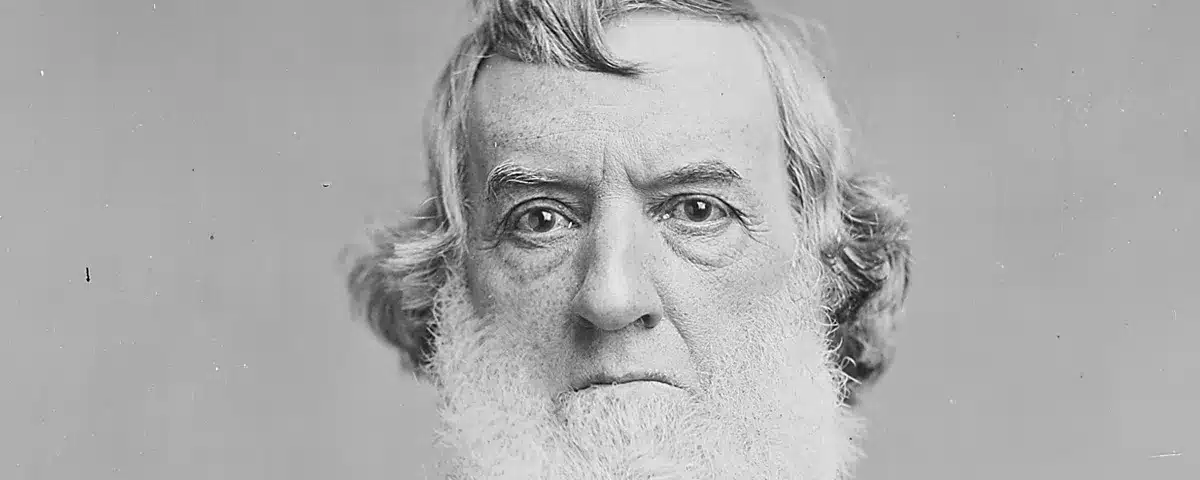
Gideon Welles (1 July 1802 – 11 February 1878) was an American government official who served as United States Secretary of the Navy from 1861 to 1869. He was instrumental in implementing the Union blockade of Confederate ports, a strategy widely credited as a major cause of Northern victory in the Civil War.
Early Life and Education
Welles was born on July 1, 1802, in Glastonbury, Connecticut, the son of Samuel Welles, a shipping merchant and fervent Jeffersonian, and Ann Hale. His father participated in the Connecticut Convention that formed the state’s first constitution in 1818, which abolished the colonial charter and established freedom of religion. Welles descended from Thomas Welles, who arrived in America in 1635 and was the only man in Connecticut’s history to hold all four top offices: governor, deputy governor, treasurer, and secretary.
He was educated at the Episcopal Academy at Cheshire, Connecticut, and earned a degree from the American Literary, Scientific, and Military Academy at Norwich, Vermont, later known as Norwich University. Rather than practicing law through formal study, Welles read the law before turning to journalism. In 1826, he founded and edited the Hartford Times.
On June 16, 1835, Welles married Mary Jane Hale in Lewiston, Pennsylvania. She was born June 18, 1817, in Glastonbury, Connecticut, daughter of Elias White Hale, a Yale College graduate and lawyer. Together they had six children. Mary Jane died on February 28, 1886, in Hartford and was buried next to her husband in Cedar Hill Cemetery.
Career and Achievements
Welles began his political career as a Jacksonian Democrat. From 1827 to 1835, he served in the Connecticut House of Representatives. He then held several posts: State Controller of Public Accounts in 1835, Postmaster of Hartford from 1836 to 1841, and Chief of the Bureau of Provisions and Clothing for the Navy from 1846 to 1849. He worked closely with Martin Van Buren and John Milton Niles, though his chief rival in Connecticut Democratic politics was Isaac Toucey, whom he would later replace at the Navy Department.
Welles abandoned the Democratic Party in 1848 to support Van Buren’s Free Soil Party campaign, primarily due to his strong anti-slavery convictions. In 1854, he shifted allegiance to the newly established Republican Party and founded the Hartford Evening Press in 1856 to promote Republican ideals. He was the Republican nominee for Connecticut governor in 1856 but finished third.
His strong support of Abraham Lincoln in the 1860 presidential election made him the natural choice from New England for Lincoln’s cabinet. Lincoln appointed Welles Secretary of the Navy in March 1861.
Notable Events and Milestones
Welles inherited a Naval Department in disarray, with Southern officers resigning en masse. His first major action was dispatching the USS Powhatan to relieve Fort Sumter on Lincoln’s orders, though Secretary of State William H. Seward countermanded the instruction and sent the ship to Fort Pickens, Florida instead. When Seward later advocated for a blockade of Southern ports, Welles argued vociferously against it but was overruled by Lincoln.
Despite his initial opposition to the blockade, Welles executed it with extraordinary effectiveness as part of the Anaconda Plan. The Navy expanded from 76 ships and 7,600 sailors in 1861 to nearly tenfold that number by 1865. Though the blockade never completely sealed all 3,500 miles of Southern coastline, it severely weakened the Confederacy’s ability to finance the war by restricting the cotton trade. Lincoln nicknamed Welles his “Neptune” in recognition of his naval leadership.
After Lincoln’s assassination, President Andrew Johnson retained Welles as Secretary of the Navy. In 1866, Welles and Seward launched the National Union Party as a third-party alternative supporting Johnson’s reconciliation policies. Welles participated prominently in Johnson’s “Swing Around the Circle” campaign that autumn. Though he recorded in his diary dismay at Johnson’s behavior during the trip, particularly the president’s tendency toward invective and direct engagement with hecklers, Welles remained loyal. On April 17 and 18, 1868, he testified as a witness for Johnson’s defense team during the impeachment trial.
Awards and Honors
Welles was instrumental in the Navy’s creation of the Medal of Honor. His achievement in expanding the Navy almost tenfold was widely praised, and his implementation of the blockade strategy was recognized as a decisive factor in Union victory during the Civil War.
Additional Resources
For further details about Welles’ life, naval career, and role in the Civil War era, readers may consult Wikipedia’s full biography and other historical archives documenting his correspondence, diaries, and official records from his tenure in the Navy Department.
Observer Voice is the one stop site for National, International news, Sports, Editor’s Choice, Art/culture contents, Quotes and much more. We also cover historical contents. Historical contents includes World History, Indian History, and what happened today. The website also covers Entertainment across the India and World.
Follow Us on Twitter, Instagram, Facebook, & LinkedIn

