

Exploring Donald Trump’s Tariff Timeline on India: From 26% to 50% to 10%

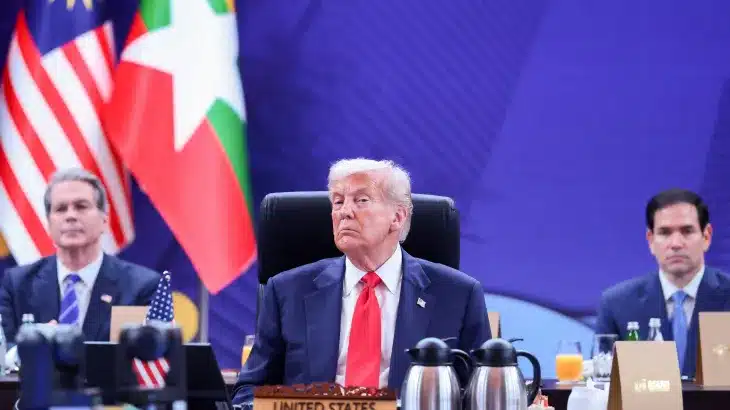
US President Donald Trump has announced a new 10% tariff on imports from all countries, including India, just hours after the US Supreme Court invalidated a key legal basis for his previous tariffs. This decision marks a significant shift in the legal foundation of his trade policy, but it does not signal an end to his tariff strategy. The Supreme Court’s ruling, which concluded that the International Emergency Economic Powers Act (IEEPA) does not authorize broad tariffs, has prompted Trump to quickly pivot to a different legal framework to maintain his aggressive trade stance.
Supreme Court Ruling and Immediate Response
In a landmark 6-3 decision, the Supreme Court ruled that the IEEPA does not grant the president the authority to impose sweeping tariffs, effectively invalidating many of the duties that Trump had implemented under emergency powers. This ruling affects a significant portion of Trump’s “reciprocal tariffs,” which had previously raised import duties on various goods worldwide. In response to this legal setback, Trump invoked Section 122 of the Trade Act of 1974, signing an executive order that imposes a 10% global tariff effective immediately. This move allows him to retain existing sector-specific tariffs and other trade levies while shifting the legal basis for his tariff policy.
The Supreme Court’s decision represents a critical juncture in Trump’s tariff campaign, which began in April 2025 and has since reshaped global trade dynamics. The ruling not only impacts the tariffs imposed on Indian exports but also sets a precedent for how future tariffs may be structured under US law. Despite the setback, Trump remains committed to using tariffs as a central element of his economic strategy, emphasizing that the India-US trade deal remains unchanged and that Indian exports will continue to face tariffs under the new framework.
Timeline of US Tariffs on India
The timeline of US tariffs on India reflects a complex and evolving trade relationship. In February 2025, Prime Minister Narendra Modi and President Trump set an ambitious goal to double bilateral trade to $500 billion by 2030, despite looming tariff tensions. Early negotiations began in March 2025, with Indian Commerce Minister Piyush Goyal visiting Washington to address trade concerns and prevent tariff escalation. However, by April 2, 2025, the US imposed a total tariff of 26% on Indian imports, which included a 10% baseline tariff and an additional 16% reciprocal tariff.
As negotiations continued, the US temporarily suspended the 16% reciprocal tariff for 90 days, reducing India’s effective tariff burden to 10%. However, tensions escalated again, leading to a new 25% tariff announced on July 31, 2025, and an additional 25% tariff linked to India’s oil purchases from Russia, bringing the total tariff burden on Indian exports to a staggering 50%. This marked the highest level of tariffs during the dispute, prompting further negotiations between the two nations.
By early 2026, Indian officials were actively working to finalize a trade agreement, which eventually led to a reduction in US tariffs on Indian goods to 18% under an interim trade deal. This agreement restored some competitiveness to Indian exports after months of elevated duties, illustrating the ongoing complexities of the trade relationship between the two countries.
Impact of Tariffs on Global Trade
The broader implications of the US tariff campaign have been significant, affecting not only India but also major trading partners like Canada, Mexico, and China. The campaign began in February 2025, with Trump imposing duties of up to 25% on various imports, signaling a shift towards more aggressive protectionist policies. The introduction of a 10% baseline tariff on imports from most countries on April 2, 2025, marked a pivotal moment, referred to as “Liberation Day,” which intensified trade tensions globally.
As the tariff campaign progressed, the administration expanded its reach, targeting specific sectors such as steel, aluminum, and automobiles. This escalation disrupted global trade flows and forced many countries to engage in negotiations with the US, leading to selective adjustments in tariffs and supply chain shifts. However, the legal foundation of these tariffs faced challenges, culminating in the Supreme Court’s ruling in February 2026, which blocked the use of emergency powers for imposing broad tariffs.
Despite this setback, Trump’s immediate response to impose a new 10% global tariff under a different legal authority ensures that tariffs remain a central component of his trade strategy. The administration has indicated its intent to utilize alternative legal provisions to sustain tariffs, signaling that the trade landscape will continue to evolve in the coming months.
Future of US Trade Policy
The future of US trade policy remains uncertain as the administration navigates the legal and economic ramifications of the Supreme Court’s ruling. Trump’s commitment to tariffs as a tool for economic strategy suggests that further adjustments and negotiations are likely. The administration’s focus on maintaining tariffs, particularly on Indian exports, underscores the ongoing complexities of international trade relations.
As the US seeks to balance its trade objectives with legal constraints, the implications for global trade dynamics will be closely monitored. The evolving relationship between the US and India, along with other trading partners, will play a crucial role in shaping the future of trade policy. With ongoing negotiations and potential adjustments to tariffs, businesses and economies worldwide will need to adapt to the changing landscape of international trade.
Observer Voice is the one stop site for National, International news, Sports, Editor’s Choice, Art/culture contents, Quotes and much more. We also cover historical contents. Historical contents includes World History, Indian History, and what happened today. The website also covers Entertainment across the India and World.

