

Constant Lambert: Founding Voice of English Ballet

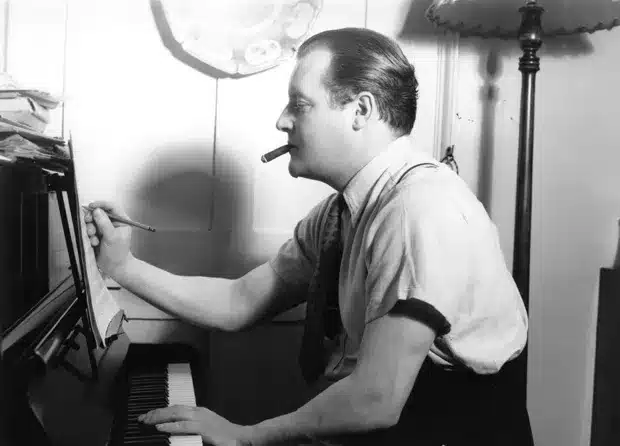
Constant Lambert (23 August 1905 – 21 August 1951) was a British composer, conductor, and author. He was the founding music director of the Royal Ballet and a major figure in establishing English ballet as a significant artistic movement alongside Dame Ninette de Valois and Sir Frederick Ashton.
Early Life and Education
Lambert was born the younger brother of Maurice Lambert to Australian painter George Lambert and his wife Amy. He was educated at Christ’s Hospital near Horsham in West Sussex, where he demonstrated formidable musical gifts and wrote his first orchestral work at age 13. In September 1922 he entered the Royal College of Music, studying composition under Ralph Vaughan Williams, R. O. Morris, and Sir George Dyson, conducting with Malcolm Sargent, and piano with Herbert Fryer. His contemporaries included pianist Angus Morrison, conductor Guy Warrack, and composers Gavin Gordon, Patrick Hadley, and Gordon Jacob.
Career and Achievements
At age 20 in 1925, Lambert received a high-profile commission from Sergei Diaghilev’s Ballets Russes to write a ballet. Roméo et Juliette (1926), choreographed by Nijinska, launched his career. He followed this with the neo-classical Pomona (1927), also choreographed by Nijinska, and gained further prominence through his participation as narrator in public performances and a recording of William Walton and Edith Sitwell’s Façade.
Lambert’s most enduring work, The Rio Grande (1927), set a poem by Sacheverell Sitwell for piano and alto soloists, chorus, and orchestra. The piece achieved considerable success and remains regularly performed; Lambert himself conducted two recordings of it in 1930 and 1949. His interest in African-American music and jazz rhythms shaped subsequent compositions including the Piano Sonata (1929) and the Concerto for piano and nine Instruments (1931), both of which integrated jazz elements with classical forms in ways that moved beyond the symphonic jazz of Gershwin and Paul Whiteman toward something more tense and urban.
In 1931 Lambert was appointed conductor and music director of the Vic-Wells ballet, which later became the Royal Ballet. He worked closely with the company until his resignation in 1947, continuing as a guest conductor thereafter. His major choral work Summer’s Last Will and Testament (1935), based on Thomas Nashe’s play, was received poorly in the mood following King George V’s death, though critic Alan Frank called it Lambert’s finest work. Later ballet scores included Horoscope (1938) and Tiresias (1951). He also composed smaller works such as Trois pièces nègres pour les touches blanches, a white-note piano suite for four hands written for identical twin pianists Mary and Geraldine Peppin.
Notable Events and Milestones
The Rio Grande premiered in 1927 and became Lambert’s most celebrated composition. His critical study Music Ho! (1934) demonstrated his wide-ranging cultural interests by placing music in the context of the other arts. Lambert’s health declined significantly during and after the Second World War; he was ruled unfit for active service and struggled with undiagnosed and untreated diabetes, compounded by decades of heavy drinking. His childhood experiences, including a near-fatal bout of septicaemia, had left him with a lifelong fear of the medical profession. Lambert died on 21 August 1951.
Additional Resources
Lambert’s life and work are documented in greater detail through Wikipedia and other biographical archives. His correspondence with figures such as John Maynard Keynes, Anthony Powell, and the Sitwells, along with his critical writings and compositions, remain available for further study. The Rio Grande continues to be performed by orchestras and choral ensembles worldwide, ensuring his compositional legacy remains accessible to contemporary audiences.
Observer Voice is the one stop site for National, International news, Sports, Editor’s Choice, Art/culture contents, Quotes and much more. We also cover historical contents. Historical contents includes World History, Indian History, and what happened today. The website also covers Entertainment across the India and World.

