

Amy Johnson: Pioneer of Long-Distance Flight

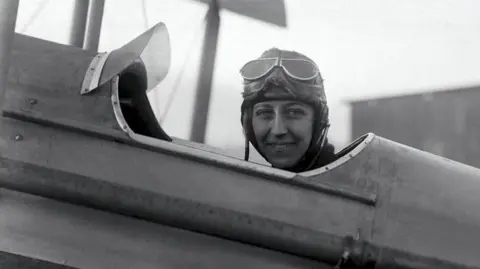
Amy Johnson (1 July 1903 – 5 January 1941) was an English pilot. She was the first woman to fly solo from London to Australia.
Early Life and Education
Johnson was born in Kingston upon Hull, East Riding of Yorkshire, the daughter of Amy Hodge and John William Johnson, whose family were fish merchants. She was the eldest of three sisters. Her grandfather, William Hodge, served as Mayor of Hull.
She attended Boulevard Municipal Secondary School, later Kingston High School, and the University of Sheffield, where she earned a Bachelor of Arts degree in economics. After university, she worked in London as a secretary to solicitor William Charles Crocker. In 1929, she obtained her aviator’s certificate on 28 January and her pilot’s “A” licence on 6 July, both at the London Aeroplane Club under Captain Valentine Baker. That same year, she became the first British woman to obtain a ground engineer’s “C” licence.
Johnson was a friend and collaborator of Fred Slingsby, whose Yorkshire-based company became the UK’s most famous glider manufacturer. She was an early member and trainee of the Yorkshire Gliding Club during the 1930s.
Career and Achievements
Johnson purchased her first aircraft, a secondhand de Havilland DH.60 Gipsy Moth named Jason, with funds from her father and Lord Wakefield. On 5 May 1930, she departed Croydon Airport in Surrey and landed at Darwin, Northern Territory on 24 May, completing an 11,000-mile solo flight and becoming the first woman to fly from England to Australia. She was awarded the Harmon Trophy and the CBE in George V’s 1930 Birthday Honours, and received Australia’s No. 1 civil pilot’s licence under the 1921 Air Navigation Regulations. Jason is now on permanent display in the Flight Gallery of the Science Museum in London.
In July 1931, Johnson and co-pilot Jack Humphreys flew a de Havilland DH.80 Puss Moth named Jason II from London to Moscow in one day, covering 1,760 miles in approximately 21 hours. They continued across Siberia to Tokyo, setting a record time for Britain to Japan.
In 1932, Johnson married Scottish pilot Jim Mollison, who proposed during a flight eight hours after they first met. That July, she set a solo record flying from London to Cape Town, South Africa, in the Puss Moth Desert Cloud, breaking her husband’s record. De Havilland and Castrol Oil featured this flight in advertising campaigns.
In July 1933, Johnson and Mollison attempted a nonstop transatlantic flight in a de Havilland DH.84 Dragon named Seafarer from Pendine Sands, South Wales, to Floyd Bennett Field in Brooklyn. Running low on fuel, they crash-landed near Bridgeport Municipal Airport in Connecticut, suffering only cuts and gashes. They were later feted by New York society and received a ticker tape parade down Wall Street.
In 1934, the Mollisons set a record time from Britain to India in a de Havilland DH.88 Comet named Black Magic as part of the England to Australia MacRobertson Air Race, though they retired at Allahabad due to engine trouble. In September 1934, Johnson became the youngest president of the Women’s Engineering Society, having served as vice-president since that year. She succeeded Elizabeth M. Kennedy and was succeeded by Edith Mary Douglas.
On 4 May 1936, Johnson made her last record-breaking flight, departing Gravesend Airport in a Percival Gull Six and regaining her Britain to South Africa record. In 1936, she received the Gold Medal of the Royal Aero Club. She joined the Midland Gliding Club in October 1937 and remained active until gliding was suspended after the Second World War began. In 1938, she overturned her glider while landing after a display at Walsall Aerodrome but was not seriously hurt.
Notable Events and Milestones
Johnson’s 1930 solo flight to Australia brought her worldwide recognition at age 26. In 1933, a character in Katharine Hepburn’s film Christopher Strong was inspired by Johnson. During the Second World War, she served as a pilot with the Air Transport Auxiliary.
On 5 January 1941, Johnson’s aircraft crashed into the Thames Estuary. She bailed out but her body was never recovered. The precise cause of her death—drowning, hypothermia, or injury from a warship’s propellers—remains unknown. The possibility of friendly fire was raised in 1999 and has since been a subject of discussion.
Awards and Honors
Johnson received the Harmon Trophy and the CBE in George V’s 1930 Birthday Honours following her England to Australia flight. In 1936, she was awarded the Gold Medal of the Royal Aero Club. She held Australia’s No. 1 civil pilot’s licence under the 1921 Air Navigation Regulations.
Additional Resources
For further details about Amy Johnson’s life, aviation records, and legacy, readers can consult Wikipedia and other biographical archives. Her aircraft Jason remains on display at the Science Museum in London, offering visitors a tangible connection to her pioneering achievements in aviation history.
Observer Voice is the one stop site for National, International news, Sports, Editor’s Choice, Art/culture contents, Quotes and much more. We also cover historical contents. Historical contents includes World History, Indian History, and what happened today. The website also covers Entertainment across the India and World.

