

James Garfield: The Reluctant Compromise President

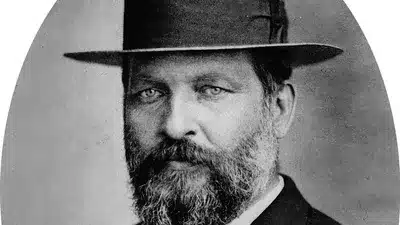
James Abram Garfield (November 19, 1831 – September 19, 1881) was the 20th president of the United States. He is the only sitting member of the House of Representatives to be elected president.
Early Life and Education
Garfield was born the youngest of five children on November 19, 1831, in a log cabin in Orange Township, Ohio, later known as Moreland Hills. His father Abraham died in 1833, leaving James to be raised in poverty by his mother Eliza in a household influenced by the Stone-Campbell church. His father’s family traced back to Edward Garfield, who migrated from Warwickshire, England, to Massachusetts around 1630.
Mocked by peers for his poverty and fatherlessness, Garfield sought refuge in reading. At age 16 in 1847, he left home seeking work but was rejected from a ship job in Cleveland. He instead worked on a canal boat managing mules until illness forced his return home. His mother and a local school official persuaded him to attend school for a year, and he began at Geauga Seminary in 1848. He excelled as a student, showing particular aptitude for languages and elocution. After graduating from Williams College in 1856, he studied law and became an attorney.
Career and Achievements
Garfield’s early career combined religious and educational work. He was a preacher in the Restoration Movement and served as president of the Western Reserve Eclectic Institute, affiliated with the Disciples. In 1859, he was elected as a Republican member of the Ohio State Senate, serving until 1861.
When the Civil War began, Garfield opposed Confederate secession and became a major general in the Union Army, fighting in the battles of Middle Creek, Shiloh, and Chickamauga. He was elected to Congress in 1862 to represent Ohio’s 19th district. Throughout his congressional service, he firmly supported the gold standard and earned a reputation as a skilled orator. His mathematical abilities led him to publish his own proof of the Pythagorean theorem in 1876. He advocated for using statistics to inform government policy and initially aligned with Radical Republican views on Reconstruction before shifting toward a Moderate Republican approach to civil rights enforcement for freedmen.
Notable Events and Milestones
At the 1880 Republican National Convention, Garfield emerged as a compromise presidential nominee on the 36th ballot, despite not having sought the presidency. He conducted a low-key front porch campaign and narrowly defeated Democratic nominee Winfield Scott Hancock in the 1880 presidential election. Before becoming president-elect, the Ohio General Assembly had elected him to the U.S. Senate, a position he declined.
As president beginning in March 1881, Garfield asserted presidential authority against senatorial courtesy in executive appointments and pursued a purge of corruption in the Post Office. He appointed a Supreme Court justice and advocated for agricultural technology, an educated electorate, and civil rights for African Americans. His most significant policy initiative was proposing substantial civil service reforms, which Congress passed in 1883 as the Pendleton Civil Service Reform Act after his death.
Garfield’s presidency was marked by conflict with the powerful “Stalwart” Senator Roscoe Conkling of New York. As a member of the intraparty “Half-Breed” faction, Garfield appointed William H. Robertson, a leader of the Blaine faction, to the lucrative post of Collector of the Port of New York. This appointment triggered a political battle that resulted in Robertson’s confirmation and the resignations of both Conkling and Thomas C. Platt from the Senate.
On July 2, 1881, Garfield was shot by Charles J. Guiteau, a deluded office seeker. He died on September 19 from infections related to the wounds and was succeeded by Vice President Chester A. Arthur.
Awards and Honors
Garfield’s mathematical contributions earned recognition through the publication of his Pythagorean theorem proof in 1876. His civil service reform proposals, though not enacted during his lifetime, were passed by Congress in 1883 as the Pendleton Civil Service Reform Act.
Additional Resources
Garfield’s brief presidency and early death have made him a subject of historical reassessment. While historians traditionally ranked him as a below-average president or omitted him from rankings due to his limited tenure and lack of major legislative achievements during his time in office, some scholars view his potential more favorably, particularly praising his anti-corruption and pro-civil rights stances. More detailed information about his life and presidency is available through Wikipedia and other biographical archives.
Observer Voice is the one stop site for National, International news, Sports, Editor’s Choice, Art/culture contents, Quotes and much more. We also cover historical contents. Historical contents includes World History, Indian History, and what happened today. The website also covers Entertainment across the India and World.

