

William Golding: Master of Lord of the Flies

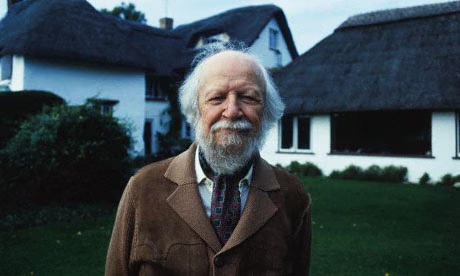
William Gerald Golding (19 September 1911 – 19 June 1993) was a British novelist, playwright, and poet. He is best known for his debut novel Lord of the Flies (1954), which became one of the most widely read works of twentieth-century fiction.
Early Life and Education
Golding was born on 19 September 1911 at his maternal grandmother’s house in Newquay, Cornwall, the son of Alec Golding, a science master at Marlborough Grammar School, and Mildred (née Curnoe). His mother was a Cornish campaigner for female suffrage who filled his childhood with old Cornish ghost stories. The family lived in Marlborough, Wiltshire, where Golding and his elder brother Joseph attended the school where their father taught.
In 1930, Golding entered Brasenose College, Oxford, reading natural sciences for two years before switching to English. He took his B.A. degree with second class honours in the summer of 1934. That same year, Macmillan & Co published a book of his poems with help from his Oxford friend Adam Bittleston.
After a year studying for a Diploma of Education at Oxford, Golding began his teaching career in 1935 at Michael Hall School, a Steiner-Waldorf school in South London. He then taught English and music at Maidstone Grammar School from 1938 to 1940, and moved to Bishop Wordsworth’s School in Salisbury in April 1940, where he taught English, philosophy, Greek, and drama.
Career and Achievements
Golding’s teaching career was interrupted by military service. He joined the Royal Navy on 18 December 1940 and served on a destroyer involved in the pursuit and sinking of the German battleship Bismarck. He participated in the invasion of Normandy on D-Day, commanding a landing craft that fired salvoes of rockets onto the beaches, and saw action at Walcheren in October and November 1944. He rose to the rank of lieutenant and returned to teaching in 1945 at Bishop Wordsworth’s School, where he remained until 1961.
Golding’s literary reputation rests primarily on Lord of the Flies, published in 1954 as his debut novel. He went on to publish another 12 volumes of fiction during his lifetime. In 1980, he won the Booker Prize for Rites of Passage, the first novel in his sea trilogy, To the Ends of the Earth. The Nobel Prize in Literature followed in 1983, recognizing his significant contributions to world literature.
Notable Events and Milestones
Beyond his major publications, Golding kept a personal journal for over 22 years beginning in 1971, which contained approximately 2.4 million words by the time of his death. The journal began as a record of his dreams but evolved into a comprehensive account of his life, including retrospective thoughts about his novels and memories from his past. In one entry, Golding described setting his students into two groups to fight each other—an experience he drew upon when writing Lord of the Flies.
Golding struggled with alcoholism throughout much of his adult life, a crisis that affected his productivity and well-being. Following the negative reception of The Spire in 1964 and the publication of The Pyramid in 1967, he experienced severe writer’s block compounded by family anxieties and insomnia. His recovery began in 1971 when he studied Carl Jung’s writings and traveled to Switzerland to engage with Jung’s landscape and ideas.
Awards and Honors
In 1980, Golding received the Booker Prize for Rites of Passage. The Nobel Prize in Literature came in 1983. He was knighted in 1988 in recognition of his contributions to literature and became a fellow of the Royal Society of Literature. In 2008, The Times ranked him third on its list of “The 50 greatest British writers since 1945.”
Additional Resources
Golding’s life and work have been extensively documented in biographical studies, most notably John Carey’s William Golding: The Man Who Wrote Lord of the Flies (2009), which drew on unprecedented access to Golding’s unpublished journals and papers granted by the Golding estate. Readers seeking deeper insight into his novels, military service, and personal struggles can find comprehensive information through Wikipedia and other biographical archives.
Observer Voice is the one stop site for National, International news, Sports, Editor’s Choice, Art/culture contents, Quotes and much more. We also cover historical contents. Historical contents includes World History, Indian History, and what happened today. The website also covers Entertainment across the India and World.

