

Augustus: Founder of the Roman Empire

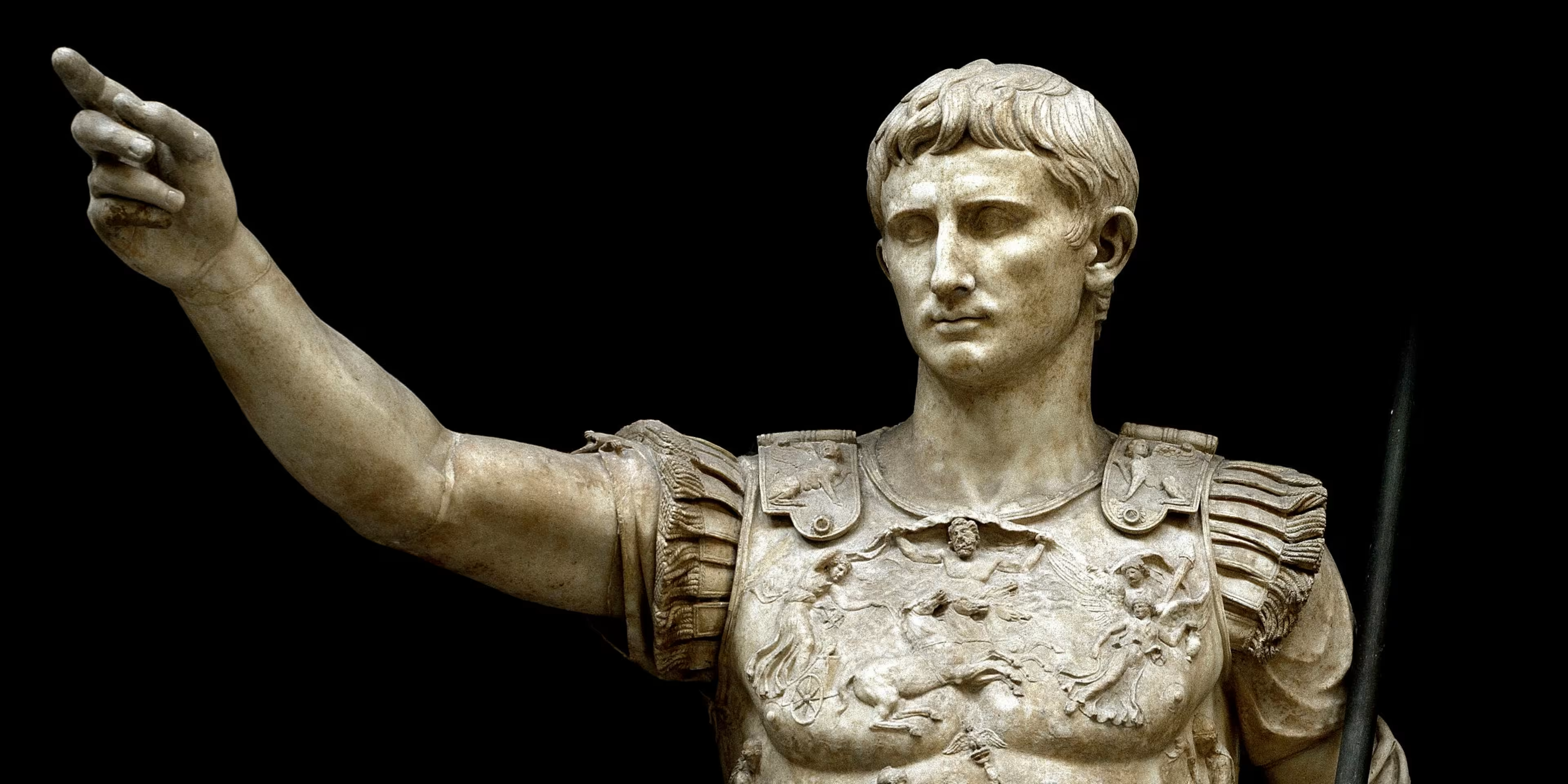
Augustus (23 September 63 BC – 19 August AD 14), also known as Octavian, was a Roman statesman and military commander. He founded the Roman Empire and served as its first emperor from 27 BC until his death, establishing an era of widespread peace known as the Pax Romana.
Early Life and Education
Octavian was born as Gaius Octavius on 23 September 63 BC in Rome, at a family property on the Palatine Hill. His father, Gaius Octavius, belonged to a moderately wealthy equestrian family of the gens Octavia and served as a proconsular governor of Macedonia. His mother, Atia, was a niece of Julius Caesar. The family originated from Velitrae, near Rome, where the younger Octavius spent part of his childhood.
After his father’s death in 59 or 58 BC, his mother remarried Lucius Marcius Philippus, who was elected consul in 56 BC. When Octavius’s grandmother Julia, sister of Julius Caesar, died in 52 or 51 BC, Octavius delivered her funeral oration, marking his first public appearance.
Career and Achievements
Julius Caesar named Octavius as his primary heir in his will. Following Caesar’s assassination in 44 BC, Octavius inherited his estate and assumed his name. He fought to secure the loyalty of Caesar’s legions and was made a senator during a state emergency. In 43 BC, at a remarkably young age, he seized power by marching on Rome and became its youngest elected consul.
Octavian formed a triumvirate with Mark Antony and Marcus Lepidus, a regime with legally sanctioned powers to eliminate Caesar’s assassins and their supporters. The triumvirate achieved victory at the Battle of Philippi in 42 BC and subsequently divided the Roman Republic among themselves, ruling as de facto oligarchs. Internal tensions eventually fractured the alliance. Octavian exiled Lepidus in 36 BC for opposing him in Sicily. Marcus Agrippa, Octavian’s naval commander, defeated Mark Antony at the Battle of Actium in 31 BC. Antony and his wife Cleopatra, the Ptolemaic queen of Egypt, killed themselves during Octavian’s invasion of Egypt, which then became his personal property.
After consolidating power, Augustus reached an accord with the Roman elite in which he ostensibly restored the republic while maintaining autocratic control through command of the military and half of Rome’s provinces. To avoid appearing as a monarch or dictator, he refused reelection to the consulship. The Senate granted him the powers of the tribunate and censorship, along with the titles princeps (‘first citizen’), augustus (‘the revered’), and pater patriae (‘father of the country’). The month of August was named in his honor. Following Lepidus’s death, Augustus also assumed the title of pontifex maximus (‘supreme pontiff’).
Augustus significantly expanded the Empire, annexing Egypt, Dalmatia, Pannonia, Noricum, and Raetia, while expanding possessions in Africa and completing the conquest of Hispania. His military ambitions suffered a major setback in Germania. Beyond Roman frontiers, he secured the empire through a buffer region of client states and negotiated peace treaties with the Parthian Empire and Kingdom of Kush.
His administrative reforms were extensive. He reformed the Roman system of taxation and currency, developed networks of roads with an official courier system, established a standing professional army, and created the Praetorian Guard. He also established official police and fire-fighting services for Rome and renovated much of the city during his reign. Augustus was a writer and patron of poets including Virgil, and has been depicted in various works of art from ancient to modern times.
Notable Events and Milestones
The reign of Augustus initiated an imperial cult and the Pax Romana, an era during which the Roman world was largely free of armed conflict. The principate, a system of government in which the emperor maintained nominal deference to the Senate, was established during his reign and persisted until the Crisis of the Third Century. In 27 BC, the Senate formally granted him the title Augustus, marking the official beginning of his reign as emperor.
Awards and Honors
Augustus received numerous honors and titles throughout his life. In 27 BC, the Senate granted him the honorific title Augustus (‘the revered’). He was also awarded the titles princeps (‘first citizen’) and pater patriae (‘father of the country’). The month of August was named after him. Following his death, the Senate posthumously deified him.
Additional Resources
Augustus remains one of history’s most studied figures, and detailed accounts of his life, reign, and reforms are available through Wikipedia and other biographical archives. His correspondence, administrative records, and the works of ancient historians such as Suetonius provide extensive documentation of his era and accomplishments.
Observer Voice is the one stop site for National, International news, Sports, Editor’s Choice, Art/culture contents, Quotes and much more. We also cover historical contents. Historical contents includes World History, Indian History, and what happened today. The website also covers Entertainment across the India and World.

