

Aaron Copland: Dean of American Music

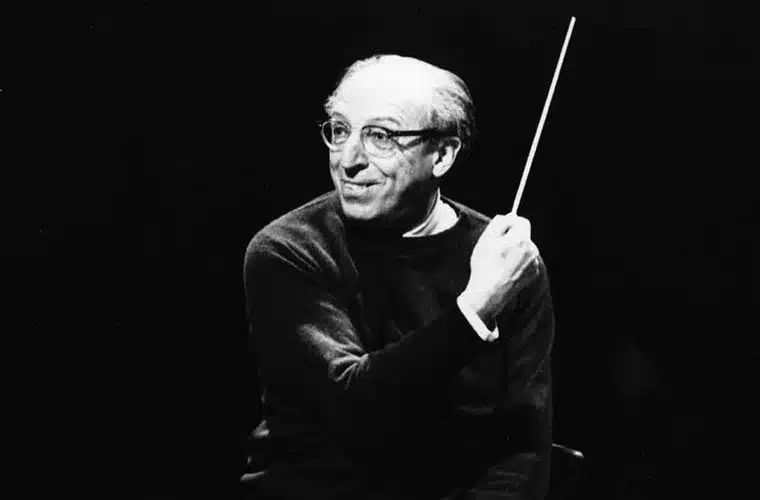
Aaron Copland (November 14, 1900 – December 2, 1990) was an American composer, critic, writer, teacher, pianist, and conductor. He was widely recognized as the “Dean of American Music” for works that captured the sound of the American landscape and pioneer spirit through open, slowly changing harmonies.
Early Life and Education
Copland was born in Brooklyn, New York, on November 14, 1900, the youngest of five children in a Conservative Jewish immigrant family of Lithuanian origin. His father, Harris Morris Copland, had emigrated from Russia via Scotland, likely Anglicizing the family surname from Kaplan during that journey—a fact Copland did not learn until late in his life. The family lived above their parents’ shop, H. M. Copland’s, at 628 Washington Avenue, a neighborhood store where most of the children worked.
His mother, Sarah Mittenthal Copland, sang, played piano, and arranged music lessons for her children. His oldest sister Laurine, a student at the Metropolitan Opera School, gave Aaron his first piano lessons and became his strongest musical influence. From 1913 to 1917, Copland studied piano with Leopold Wolfsohn. He began writing songs at age eight and a half, and by age 15, after hearing Polish composer-pianist Ignacy Jan Paderewski perform, he resolved to become a composer. Between 1917 and 1921, he studied harmony, theory, and composition with Rubin Goldmark, a noted teacher and composer of American music.
Career and Achievements
After his studies with Goldmark, Copland traveled to Paris, where he studied first with Isidor Philipp and Paul Vidal, then spent three years with the noted pedagogue Nadia Boulanger. Her eclectic approach to music shaped his own broad musical taste. Upon returning to the United States, Copland initially pursued composing in a modernist style but found orchestral music in that idiom unprofitable, particularly during the Great Depression.
In the mid-1930s, he shifted to a more accessible musical style inspired by the German concept of Gebrauchsmusik—music that could serve both utilitarian and artistic purposes. During the Depression years, he traveled extensively to Europe, Africa, and Mexico, formed an important friendship with Mexican composer Carlos Chávez, and began composing his signature works. He is best known for ballets written in the 1930s and 1940s, including Appalachian Spring, Billy the Kid, and Rodeo, along with his Fanfare for the Common Man and Third Symphony. Beyond ballets and orchestral works, he composed chamber music, vocal works, opera, and film scores.
In the late 1940s, Copland became aware that composers including Stravinsky had begun studying Arnold Schoenberg’s twelve-tone serial techniques. After encountering the works of French composer Pierre Boulez, he incorporated serial techniques into his Piano Quartet (1950), Piano Fantasy (1957), Connotations for orchestra (1961), and Inscape for orchestra (1967). Unlike Schoenberg, Copland used tone rows as sources for melodies and harmonies rather than as complete structural statements, except at crucial structural points.
From the 1960s onward, Copland’s focus shifted from composing to conducting. He became a frequent guest conductor of orchestras in the United States and the United Kingdom and made a series of recordings of his music, primarily for Columbia Records.
Notable Events and Milestones
Copland’s first public music performance was at a Wanamaker’s recital. At age 16, he heard his first symphony at the Brooklyn Academy of Music. His earliest notated music, about seven bars written at age 11, was for an opera scenario he called Zenatello. The shift to his accessible “vernacular” style in the mid-1930s marked a turning point in his career, allowing him to achieve both artistic and popular success during a period of economic hardship.
Awards and Honors
Copland was referred to by his peers and critics as the “Dean of American Music,” a title reflecting his central role in establishing a distinctly American musical voice. While the source does not detail specific awards or honors with dates, his recognition as a leading figure in American music came through his compositions and his influence on the field.
Additional Resources
Aaron Copland’s life and work are documented extensively in biographical archives and music history resources. Readers seeking more detailed information about his compositions, conducting career, and influence on American music can consult comprehensive biographical sources and recordings of his works, which remain central to the American classical music repertoire.
Observer Voice is the one stop site for National, International news, Sports, Editor’s Choice, Art/culture contents, Quotes and much more. We also cover historical contents. Historical contents includes World History, Indian History, and what happened today. The website also covers Entertainment across the India and World.

